文章目录
- 数学表达式: PyTorch实现: torch.nn.ReLU(inplace=False) 特点: 计算简单高效 解决梯度消失问题(正区间) 可能导致"神经元死亡"(负区间梯度为0),ReLU 在输入为负时输出恒为 0,导致反向传播中梯度消失,相关权重无法更新14。若神经元长期处于负输入状态,则会永久“死亡”,失去学习能力。 示例: relu = nn.ReLU() input = torch.tensor([-1.0, 0.0, 1.0, 2.0]) output = relu(input) # tensor([0., 0., 1., 2.])
- 数学表达式: PyTorch实现: torch.nn.LeakyReLU(negative_slope=0.01, inplace=False) 特点: 解决了ReLU的"神经元死亡"问题,通过引入负区间的微小斜率(如 torch.nn.LeakyReLU(negative_slope=0.01)),保留负输入的梯度传播,避免神经元死亡。 negative_slope通常设为0.01 示例 leaky_relu = nn.LeakyReLU(negative_slope=0.1) input = torch.tensor([-1.0, 0.0, 1.0, 2.0]) output = leaky_relu(input) # tensor([-0.1000, 0.0000, 1.0000, 2.0000])
- 数学表达式: PyTorch实现: torch.nn.Sigmoid() 特点: 输出范围(0,1),适合二分类问题 容易出现梯度消失问题 输出不以0为中心 示例: sigmoid = nn.Sigmoid() input = torch.tensor([-1.0, 0.0, 1.0, 2.0]) output = sigmoid(input) # tensor([0.2689, 0.5000, 0.7311, 0.8808])
- 数学表达式: PyTorch实现: torch.nn.Tanh() 特点: 输出范围(-1,1),以0为中心 比sigmoid梯度更强 仍存在梯度消失问题 示例: tanh = nn.Tanh() input = torch.tensor([-1.0, 0.0, 1.0, 2.0]) output = tanh(input) # tensor([-0.7616, 0.0000, 0.7616, 0.9640])
- 数学表达式: PyTorch实现: torch.nn.Softmax(dim=None) 特点: 输出为概率分布(和为1) 常用于多分类问题的输出层 dim参数指定计算维度 示例: softmax = nn.Softmax(dim=1) input = torch.tensor([[1.0, 2.0, 3.0]]) output = softmax(input) # tensor([[0.0900, 0.2447, 0.6652]])
目录
- 常用激活函数
- 1. ReLU (Rectified Linear Unit)
- 2. LeakyReLU
- 3. Sigmoid
- 4. Tanh (Hyperbolic Tangent)
- 5. Softmax
- 其他激活函数
- 6. ELU (Exponential Linear Unit)
- 7. GELU (Gaussian Error Linear Unit)
- 8. Swish
- 选择指南
- 自定义激活函数
- 注意事项
激活函数是神经网络中至关重要的组成部分,它们为网络引入了非线性特性,使得神经网络能够学习复杂模式。PyTorch 提供了多种常用的激活函数实现。
数学表达式:

PyTorch实现:
torch.nn.ReLU(inplace=False)
特点:
- 计算简单高效
- 解决梯度消失问题(正区间)
- 可能导致"神经元死亡"(负区间梯度为0),ReLU 在输入为负时输出恒为 0,导致反向传播中梯度消失,相关权重无法更新14。若神经元长期处于负输入状态,则会永久“死亡”,失去学习能力。
示例:
relu = nn.ReLU()
input = torch.tensor([-1.0, 0.0, 1.0, 2.0])
output = relu(input)  # tensor([0., 0., 1., 2.])
数学表达式:
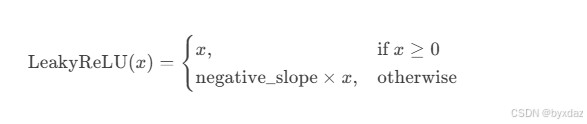
PyTorch实现:
torch.nn.LeakyReLU(negative_slope=0.01, inplace=False)
特点:
- 解决了ReLU的"神经元死亡"问题,通过引入负区间的微小斜率(如 torch.nn.LeakyReLU(negative_slope=0.01)),保留负输入的梯度传播,避免神经元死亡。
- negative_slope通常设为0.01
示例
leaky_relu = nn.LeakyReLU(negative_slope=0.1)
input = torch.tensor([-1.0, 0.0, 1.0, 2.0])
output = leaky_relu(input)  # tensor([-0.1000, 0.0000, 1.0000, 2.0000])
数学表达式:

PyTorch实现:
torch.nn.Sigmoid()
特点:
- 输出范围(0,1),适合二分类问题
- 容易出现梯度消失问题
- 输出不以0为中心
示例:
sigmoid = nn.Sigmoid()
input = torch.tensor([-1.0, 0.0, 1.0, 2.0])
output = sigmoid(input)  # tensor([0.2689, 0.5000, 0.7311, 0.8808])
数学表达式:

PyTorch实现:
torch.nn.Tanh()
特点:
- 输出范围(-1,1),以0为中心
- 比sigmoid梯度更强
- 仍存在梯度消失问题
示例:
tanh = nn.Tanh()
input = torch.tensor([-1.0, 0.0, 1.0, 2.0])
output = tanh(input)  # tensor([-0.7616, 0.0000, 0.7616, 0.9640])
数学表达式:

PyTorch实现:
torch.nn.Softmax(dim=None)
特点:
- 输出为概率分布(和为1)
- 常用于多分类问题的输出层
- dim参数指定计算维度
示例:
softmax = nn.Softmax(dim=1)
input = torch.tensor([[1.0, 2.0, 3.0]])
output = softmax(input)  # tensor([[0.0900, 0.2447, 0.6652]])
torch.nn.ELU(alpha=1.0, inplace=False)
torch.nn.GELU()
class Swish(nn.Module):
    def forward(self, x):
        return x * torch.sigmoid(x)
- 隐藏层:通常首选ReLU及其变体(LeakyReLU、ELU等)
- 二分类输出层:Sigmoid
- 多分类输出层:Softmax
- 需要负输出的情况:Tanh或LeakyReLU
- Transformer模型:常用GELU
PyTorch可以轻松实现自定义激活函数:
class CustomActivation(nn.Module):
    def __init__(self):
        super().__init__()

    def forward(self, x):
        return torch.where(x > 0, x, torch.exp(x) - 1)
- 梯度消失/爆炸问题
- 死亡神经元问题(特别是ReLU)
- 计算效率考虑
- 初始化方法应与激活函数匹配
您可能感兴趣的文章:
- 使用Pytorch实现Swish激活函数的示例详解
- pytorch/transformers 最后一层不加激活函数的原因分析
- pytorch自定义不可导激活函数的操作
- pytorch方法测试——激活函数(ReLU)详解
- PyTorch中常用的激活函数的方法示例