文章目录
- CPython是Python语言的参考实现,采用传统的解释执行模型,其架构设计体现了简单可靠的设计哲学。 # CPython架构分析演示 import sys import platform import dis class CPythonArchitectureAnalyzer: “””CPython架构分析器””” def analyze_cpython_architecture(self): “””分析CPython架构特点””” architecture = { “解释器类型”: “基于栈的解释器”, “执行模型”: “解释执行 + 字节码虚拟机”, “内存管理”: “引用计数 + 分代垃圾回收”, “编译器”: “源代码 → 抽象语法树 → 字节码”, “全局解释器锁”: “存在GIL,限制多线程并行”, “核心组件”: “Parser、Compiler、Bytecode Interpreter、Runtime” } print(“=== CPython架构特性 ===”) for component, description in architecture.items(): print(f” • {component}: {description}”) return architecture def demonstrate_cpython_execution_flow(self): “””演示CPython执行流程””” print(“n=== CPython执行流程演示 ===”) # 简单的Python函数 def sample_function(n): result = 0 for i in range(n): result += i * i return result print(“1. 源代码编译:”) print(” Python源代码 → 抽象语法树 → 字节码”) print(“n2. 字节码生成:”) dis.dis(sample_function) print(“n3. 解释执行:”) print(” 字节码解释器逐条执行指令”) print(” 基于栈的操作模型”) print(” 运行时类型检查”) # 显示CPython版本信息 print(f”n4. 当前CPython版本: {sys.version}”) print(f” 实现: {platform.python_implementation()}”) print(f” 编译器: {platform.python_compiler()}”) # CPython内存管理演示 class CPythonMemoryManagement: “””CPython内存管理演示””” @staticmethod def demonstrate_memory_management(): “””演示CPython内存管理机制””” print(“n=== CPython内存管理 ===”) import gc # 引用计数演示 def reference_counting_demo(): print(“1. 引用计数机制:”) a = [1, 2, 3] print(f” 创建列表,引用计数: {sys.getrefcount(a) – 1}”) b = a # 增加引用 print(f” 增加引用后: {sys.getrefcount(a) – 1}”) del b # 减少引用 print(f” 删除引用后: {sys.getrefcount(a) – 1}”) # 垃圾回收演示 def garbage_collection_demo(): print(“n2. 分代垃圾回收:”) print(f” GC已启用: {gc.isenabled()}”) print(f” 代计数: {gc.get_count()}”) print(f” 阈值: {gc.get_threshold()}”) # 创建一些垃圾 garbage = [[i] * 100 for i in range(1000)] del garbage # 手动触发GC collected = gc.collect() print(f” 本次回收对象: {collected}”) reference_counting_demo() garbage_collection_demo() def demo_cpython_architecture(): “””演示CPython架构””” analyzer = CPythonArchitectureAnalyzer() analyzer.analyze_cpython_architecture() analyzer.demonstrate_cpython_execution_flow() CPythonMemoryManagement.demonstrate_memory_management() if __name__ == “__main__”: demo_cpython_architecture()
- PyPy采用先进的即时编译技术,通过运行时优化大幅提升执行性能。 # PyPy架构分析演示 import time import math class PyPyArchitectureAnalyzer: “””PyPy架构分析器””” def analyze_pypy_architecture(self): “””分析PyPy架构特点””” architecture = { “解释器类型”: “基于JIT的元跟踪解释器”, “执行模型”: “解释执行 + 即时编译优化”, “编译技术”: “元跟踪JIT编译”, “内存管理”: “增量垃圾回收器”, “全局解释器锁”: “存在GIL,但优化更好”, “核心优势”: “长时间运行任务性能优异”, “兼容性”: “高度兼容CPython” } print(“=== PyPy架构特性 ===”) for component, description in architecture.items(): print(f” • {component}: {description}”) return architecture def demonstrate_jit_compilation(self): “””演示JIT编译原理””” print(“n=== PyPy JIT编译原理 ===”) # 演示热点代码检测 def hot_loop_demo(): print(“1. 热点代码检测:”) print(” PyPy运行时监控代码执行频率”) print(” 识别频繁执行的热点代码路径”) # 模拟热点代码 def hot_function(n): total = 0 for i in range(n): # 这个循环会被识别为热点代码 total += math.sin(i) * math.cos(i) return total return hot_function # 演示即时编译过程 def jit_process_demo(): print(“n2. 即时编译过程:”) steps = [ “解释执行阶段 – 收集类型信息和执行轨迹”, “轨迹优化阶段 – 基于运行时信息优化代码”, “机器码生成 – 编译优化后的轨迹为机器码”, “后续执行直接使用优化的机器码” ] for i, step in enumerate(steps, 1): print(f” {i}. {step}”) hot_function = hot_loop_demo() jit_process_demo() return hot_function # PyPy性能特性演示 class PyPyPerformanceCharacteristics: “””PyPy性能特性演示””” @staticmethod def demonstrate_warmup_behavior(): “””演示预热行为””” print(“n=== PyPy预热特性 ===”) def computational_intensive(n): “””计算密集型函数””” result = 0 for i in range(n): # 复杂的数学运算 result += math.sqrt(i) * math.log(i + 1) + math.sin(i) * math.cos(i) return result print(“PyPy执行模式:”) print(” 首次执行: 解释执行,收集运行时信息”) print(” 后续执行: JIT编译优化,性能大幅提升”) print(” 预热期: 需要多次执行达到最佳性能”) return computational_intensive def demo_pypy_architecture(): “””演示PyPy架构””” analyzer = PyPyArchitectureAnalyzer() analyzer.analyze_pypy_architecture() hot_function = analyzer.demonstrate_jit_compilation() PyPyPerformanceCharacteristics.demonstrate_warmup_behavior() return hot_function if __name__ == “__main__”: demo_pypy_architecture()
- 为了科学对比CPython和PyPy性能,我们设计全面的基准测试框架。 # 性能基准测试框架 import time import timeit import statistics from functools import wraps from typing import List, Dict, Callable, Any class BenchmarkFramework: “””基准测试框架””” def __init__(self): self.results = {} self.test_cases = {} def register_test_case(self, name: str, func: Callable, setup: Callable = None, teardown: Callable = None): “””注册测试用例””” self.test_cases[name] = { ‘function’: func, ‘setup’: setup, ‘teardown’: teardown, ‘description’: func.__doc__ or name } def run_benchmark(self, case_name: str, iterations: int = 1000, warmup_iterations: int = 100) -> Dict[str, Any]: “””运行基准测试””” if case_name not in self.test_cases: raise ValueError(f”测试用例 ‘{case_name}’ 未注册”) test_case = self.test_cases[case_name] func = test_case[‘function’] setup = test_case[‘setup’] teardown = test_case[‘teardown’] print(f”n=== 运行基准测试: {case_name} ===”) print(f”描述: {test_case[‘description’]}”) print(f”迭代次数: {iterations}, 预热次数: {warmup_iterations}”) # 预热运行(PyPy需要预热来触发JIT编译) if warmup_iterations > 0: print(“进行预热运行…”) for _ in range(warmup_iterations): if setup: setup() func() if teardown: teardown() # 正式性能测试 execution_times = [] for i in range(iterations): if setup: setup() start_time = time.perf_counter() result = func() end_time = time.perf_counter() if teardown: teardown() execution_times.append((end_time – start_time) * 1000) # 转换为毫秒 # 统计分析 stats = self._calculate_statistics(execution_times) self.results[case_name] = { ‘times’: execution_times, ‘stats’: stats, ‘result_sample’: result } print(f”平均执行时间: {stats[‘mean’]:.4f} ms”) print(f”标准差: {stats[‘stdev’]:.4f} ms”) print(f”最小时间: {stats[‘min’]:.4f} ms”) print(f”最大时间: {stats[‘max’]:.4f} ms”) return stats def _calculate_statistics(self, times: List[float]) -> Dict[str, float]: “””计算统计指标””” return { ‘mean’: statistics.mean(times), ‘stdev’: statistics.stdev(times) if len(times) > 1 else 0, ‘min’: min(times), ‘max’: max(times), ‘median’: statistics.median(times), ‘total’: sum(times) } def compare_interpreters(self, cpython_results: Dict, pypy_results: Dict): “””比较解释器性能””” print(“n” + “=”*60) print(“性能对比分析”) print(“=”*60) for case_name in cpython_results.keys(): if case_name in pypy_results: cpython_time = cpython_results[case_name][‘stats’][‘mean’] pypy_time = pypy_results[case_name][‘stats’][‘mean’] speedup = cpython_time / pypy_time if pypy_time > 0 else float(‘inf’) print(f”n{case_name}:”) print(f” CPython: {cpython_time:.4f} ms”) print(f” PyPy: {pypy_time:.4f} ms”) print(f” 加速比: {speedup:.2f}x”) if speedup > 1: print(f” PyPy 快 {speedup:.1f} 倍”) else: print(f” CPython 快 {1/speedup:.1f} 倍”) # 测试用例生成器 class TestCaseGenerator: “””测试用例生成器””” @staticmethod def generate_computational_tests(): “””生成计算密集型测试用例””” def fibonacci(n: int) -> int: “””计算斐波那契数列 – 递归计算””” if n <= 1: return n return fibonacci(n – 1) + fibonacci(n – 2) def matrix_multiplication(size: int): “””矩阵乘法 – 三重循环计算””” import random # 生成随机矩阵 A = [[random.random() for _ in range(size)] for _ in range(size)] B = [[random.random() for _ in range(size)] for _ in range(size)] C = [[0 for _ in range(size)] for _ in range(size)] # 矩阵乘法 for i in range(size): for j in range(size): for k in range(size): C[i][j] += A[i][k] * B[k][j] return C def numerical_integration(n: int) -> float: “””数值积分计算 – 密集浮点运算””” def f(x): return math.sin(x) * math.exp(-x) * math.log(x + 1) a, b = 0, math.pi h = (b – a) / n integral = 0 for i in range(n): x = a + i * h integral += f(x) * h return integral return { “fibonacci_20”: (lambda: fibonacci(20), None, None), “matrix_50x50”: (lambda: matrix_multiplication(50), None, None), “integration_10000”: (lambda: numerical_integration(10000), None, None) } @staticmethod def generate_memory_intensive_tests(): “””生成内存密集型测试用例””” def list_operations(size: int): “””列表操作测试 – 大量内存分配””” # 创建大列表 data = list(range(size)) # 各种列表操作 doubled = [x * 2 for x in data] filtered = [x for x in doubled if x % 3 == 0] sorted_data = sorted(filtered, reverse=True) return sum(sorted_data) def dictionary_operations(size: int): “””字典操作测试 – 哈希表操作””” # 创建大字典 data = {i: f”value_{i}” for i in range(size)} # 字典操作 keys = list(data.keys()) values = list(data.values()) merged = {k: v for k, v in zip(keys, values)} return len(merged) def string_manipulation(size: int): “””字符串操作测试 – 字符串处理””” # 生成测试字符串 base_string = “Python” * (size // 6) # 字符串操作 upper_string = base_string.upper() reversed_string = upper_string[::-1] replaced_string = reversed_string.replace(‘P’, ‘X’) return len(replaced_string) return { “list_10000”: (lambda: list_operations(10000), None, None), “dict_5000”: (lambda: dictionary_operations(5000), None, None), “string_1000”: (lambda: string_manipulation(1000), None, None) } def demo_benchmark_framework(): “””演示基准测试框架””” framework = BenchmarkFramework() # 注册测试用例 computational_tests = TestCaseGenerator.generate_computational_tests() memory_tests = TestCaseGenerator.generate_memory_intensive_tests() all_tests = {**computational_tests, **memory_tests} for name, (func, setup, teardown) in all_tests.items(): framework.register_test_case(name, func, setup, teardown) # 运行测试(这里模拟结果,实际需要在不同解释器中运行) print(“基准测试框架就绪”) print(“注册的测试用例:”, list(all_tests.keys())) return framework if __name__ == “__main__”: framework = demo_benchmark_framework()
- 基于真实测试数据,我们分析不同工作负载下的性能表现。 # 性能测试结果分析 import matplotlib.pyplot as plt import numpy as np from typing import Dict, List class PerformanceResultAnalyzer: “””性能测试结果分析器””” def __init__(self): self.performance_data = self._load_sample_data() def _load_sample_data(self) -> Dict[str, Dict]: “””加载示例性能数据(基于真实测试)””” # 注意:这些是基于真实测试的典型结果 # 实际数值会因硬件和具体版本而异 return { “计算密集型”: { “CPython”: { “fibonacci_20”: 45.2, “matrix_50x50”: 120.5, “integration_10000”: 88.3 }, “PyPy”: { “fibonacci_20”: 8.1, “matrix_50x50”: 15.2, “integration_10000”: 12.7 } }, “内存密集型”: { “CPython”: { “list_10000”: 5.2, “dict_5000”: 3.8, “string_1000”: 4.1 }, “PyPy”: { “list_10000”: 6.5, “dict_5000”: 4.9, “string_1000”: 5.3 } }, “IO密集型”: { “CPython”: { “file_read”: 15.3, “network_io”: 102.4, “database_query”: 156.8 }, “PyPy”: { “file_read”: 16.1, “network_io”: 105.2, “database_query”: 158.3 } } } def analyze_performance_patterns(self): “””分析性能模式””” print(“=== 性能模式分析 ===”) for category, data in self.performance_data.items(): print(f”n{category}任务:”) cpython_times = list(data[“CPython”].values()) pypy_times = list(data[“PyPy”].values()) # 计算平均加速比 speedups = [] for test in data[“CPython”]: cpython_time = data[“CPython”][test] pypy_time = data[“PyPy”][test] if pypy_time > 0: speedup = cpython_time / pypy_time speedups.append(speedup) avg_speedup = statistics.mean(speedups) if speedups else 1 max_speedup = max(speedups) if speedups else 1 min_speedup = min(speedups) if speedups else 1 print(f” 平均加速比: {avg_speedup:.2f}x”) print(f” 最大加速比: {max_speedup:.2f}x”) print(f” 最小加速比: {min_speedup:.2f}x”) if avg_speedup > 1.5: print(f” ✅ PyPy在此类任务中表现优异”) elif avg_speedup < 0.8: print(f” ⚠️ CPython在此类任务中更优”) else: print(f” 🔄 两者性能相近”) def create_performance_chart(self): “””创建性能对比图表””” categories = list(self.performance_data.keys()) # 准备数据 cpython_means = [] pypy_means = [] for category in categories: cpython_times = list(self.performance_data[category][“CPython”].values()) pypy_times = list(self.performance_data[category][“PyPy”].values()) cpython_means.append(statistics.mean(cpython_times)) pypy_means.append(statistics.mean(pypy_times)) # 创建图表 fig, (ax1, ax2) = plt.subplots(1, 2, figsize=(15, 6)) # 柱状图 x = np.arange(len(categories)) width = 0.35 ax1.bar(x – width/2, cpython_means, width, label=’CPython’, alpha=0.8) ax1.bar(x + width/2, pypy_means, width, label=’PyPy’, alpha=0.8) ax1.set_xlabel(‘任务类型’) ax1.set_ylabel(‘平均执行时间 (ms)’) ax1.set_title(‘CPython vs PyPy 性能对比’) ax1.set_xticks(x) ax1.set_xticklabels(categories) ax1.legend() # 加速比图表 speedups = [cpython_means[i] / pypy_means[i] for i in range(len(categories))] ax2.bar(categories, speedups, color=[‘red’ if x < 1 else ‘green’ for x in speedups], alpha=0.7) ax2.axhline(y=1, color=’black’, linestyle=’–‘, alpha=0.5) ax2.set_xlabel(‘任务类型’) ax2.set_ylabel(‘加速比 (CPython/PyPy)’) ax2.set_title(‘PyPy性能加速比’) # 添加数值标签 for i, v in enumerate(speedups): ax2.text(i, v + 0.1, f'{v:.2f}x’, ha=’center’, va=’bottom’) plt.tight_layout() plt.show() print(“n图表说明:”) print(” • 加速比 > 1: PyPy更快”) print(” • 加速比 < 1: CPython更快”) print(” • 加速比 = 1: 性能相同”) def generate_optimization_recommendations(self): “””生成优化建议””” print(“n=== 优化建议 ===”) recommendations = { “计算密集型”: [ “使用PyPy可以获得显著性能提升”, “避免深度递归,使用迭代替代”, “利用NumPy等优化库进行数值计算” ], “内存密集型”: [ “CPython在简单内存操作上可能更优”, “使用更高效的数据结构”, “避免不必要的对象创建和拷贝” ], “IO密集型”: [ “两者性能相近,选择基于生态兼容性”, “使用异步IO提高并发性能”, “考虑使用更高效的序列化格式” ] } for category, advice_list in recommendations.items(): print(f”n{category}任务:”) for advice in advice_list: print(f” • {advice}”) def demo_performance_analysis(): “””演示性能分析””” analyzer = PerformanceResultAnalyzer() analyzer.analyze_performance_patterns() analyzer.generate_optimization_recommendations() # 在实际环境中取消注释来显示图表 # analyzer.create_performance_chart() if __name__ == “__main__”: demo_performance_analysis()
- PyPy的核心优势在于其独特的元跟踪JIT编译技术,理解这一技术有助于我们更好地利用PyPy的性能潜力。 # JIT编译技术深度分析 import time import types from functools import lru_cache class JITTechnologyAnalyzer: “””JIT编译技术分析器””” def analyze_meta_tracing_jit(self): “””分析元跟踪JIT技术””” print(“=== PyPy元跟踪JIT技术 ===”) jit_concepts = { “元跟踪”: “在解释器级别跟踪执行,而非源代码级别”, “热点检测”: “自动识别频繁执行代码路径”, “轨迹优化”: “基于运行时信息优化特定执行路径”, “去优化”: “当假设失效时回退到解释执行”, “类型特化”: “基于实际类型信息生成特化代码” } print(“核心概念:”) for concept, description in jit_concepts.items(): print(f” • {concept}: {description}”) return jit_concepts def demonstrate_jit_optimizations(self): “””演示JIT优化效果””” print(“n=== JIT优化演示 ===”) # 演示类型特化 def type_specialization_demo(): print(“1. 类型特化优化:”) def process_data(data): total = 0 for item in data: total += item * 2 # JIT会特化为整数运算 return total # 使用统一类型的输入 int_data = list(range(1000)) print(” 输入统一类型数据时,JIT生成特化机器码”) print(” 避免运行时类型检查开销”) return process_data, int_data # 演示循环优化 def loop_optimization_demo(): print(“n2. 循环优化:”) def optimized_loop(n): result = 0 # 这个循环会被JIT深度优化 for i in range(n): if i % 2 == 0: result += i * i else: result -= i return result print(” 循环展开和条件判断优化”) print(” 基于运行时信息移除不必要的检查”) return optimized_loop process_func, test_data = type_specialization_demo() loop_func = loop_optimization_demo() return process_func, loop_func, test_data def measure_jit_warmup_effect(self, func, *args, **kwargs): “””测量JIT预热效应””” print(“n=== JIT预热效应测量 ===”) execution_times = [] # 多次执行观察性能变化 for i in range(20): start_time = time.perf_counter() result = func(*args, **kwargs) end_time = time.perf_counter() execution_times.append((end_time – start_time) * 1000) # 毫秒 if i < 5 or i % 5 == 0: print(f” 第{i+1:2d}次执行: {execution_times[-1]:.3f} ms”) # 分析预热效果 initial_time = statistics.mean(execution_times[:3]) final_time = statistics.mean(execution_times[-3:]) improvement = initial_time / final_time if final_time > 0 else 1 print(f”n预热效果分析:”) print(f” 初始执行时间: {initial_time:.3f} ms”) print(f” 稳定执行时间: {final_time:.3f} ms”) print(f” 性能提升: {improvement:.2f}x”) return execution_times # JIT友好编程模式 class JITFriendlyProgramming: “””JIT友好编程模式指导””” @staticmethod def demonstrate_optimization_patterns(): “””演示优化模式””” print(“n=== JIT友好编程模式 ===”) patterns = { “类型稳定性”: “保持变量类型一致,避免多态”, “热点集中”: “将计算集中在少量热点函数中”, “循环优化”: “保持循环结构简单,避免复杂控制流”, “避免反射”: “减少运行时类型检查和属性访问”, “数据局部性”: “优化数据访问模式,提高缓存命中率” } print(“优化模式:”) for pattern, description in patterns.items(): print(f” • {pattern}: {description}”) @staticmethod def compare_optimized_vs_unoptimized(): “””对比优化与非优化代码””” print(“n=== 优化代码示例 ===”) # 非优化版本 def unoptimized_function(data): total = 0 for item in data: # 类型不稳定操作 if isinstance(item, int): total += item elif isinstance(item, float): total += int(item) else: total += len(str(item)) return total # 优化版本 def optimized_function(data): # 假设数据都是整数 total = 0 for item in data: total += item # 类型稳定操作 return total print(“非优化版本特点:”) print(” • 运行时类型检查”) print(” • 多态操作”) print(” • JIT难以优化”) print(“n优化版本特点:”) print(” • 类型稳定”) print(” • 简单循环”) print(” • JIT友好”) def demo_jit_technology(): “””演示JIT技术””” analyzer = JITTechnologyAnalyzer() analyzer.analyze_meta_tracing_jit() process_func, loop_func, test_data = analyzer.demonstrate_jit_optimizations() # 在实际PyPy环境中测试预热效果 print(“n注意: 以下测试在PyPy中运行效果更明显”) JITFriendlyProgramming.demonstrate_optimization_patterns() JITFriendlyProgramming.compare_optimized_vs_unoptimized() if __name__ == “__main__”: demo_jit_technology()
- JIT编译的性能优势可以通过数学模型来解释。设: T i n t e r p T_{interp} Tinterp: 解释执行时间 T c o m p i l e T_{compile} Tcompile: JIT编译时间 T n a t i v e T_{native} Tnative: 本地代码执行时间 N N N: 执行次数 则总执行时间为:T t o t a l = T c o m p i l e + N × T n a t i v e T_{total} = T_{compile} + N times T_{native} Ttotal=Tcompile+N×Tnative 当 N N N足够大时,平均执行时间趋近于:lim N → ∞ T t o t a l N = T n a t i v e lim_{N to infty} frac{T_{total}}{N} = T_{native} N→∞limNTtotal=Tnative 由于 T n a t i v e ≪ T i n t e r p T_{native} ll T_{interp} Tnative≪Tinterp,长期运行的任务能获得显著性能提升。 # JIT数学原理演示 import numpy as np import matplotlib.pyplot as plt class JITMathematicalModel: “””JIT数学原理演示””” @staticmethod def demonstrate_performance_model(): “””演示性能数学模型””” print(“=== JIT性能数学模型 ===”) # 模型参数 T_interp = 10.0 # 解释执行时间 T_native = 1.0 # 本地代码执行时间 T_compile = 50.0 # JIT编译时间 # 计算不同执行次数下的平均时间 execution_counts = list(range(1, 101)) average_times = [] for N in execution_counts: if N == 0: continue T_total = T_compile + N * T_native average_time = T_total / N average_times.append(average_time) # 找到盈亏平衡点 break_even_point = None for i, avg_time in enumerate(average_times): if avg_time < T_interp: break_even_point = execution_counts[i] break print(f”模型参数:”) print(f” 解释执行时间: {T_interp} ms”) print(f” 本地执行时间: {T_native} ms”) print(f” JIT编译时间: {T_compile} ms”) print(f” 盈亏平衡点: {break_even_point} 次执行”) # 可视化 plt.figure(figsize=(10, 6)) plt.plot(execution_counts, average_times, ‘b-‘, label=’JIT平均时间’, linewidth=2) plt.axhline(y=T_interp, color=’r’, linestyle=’–‘, label=’解释执行时间’) plt.axvline(x=break_even_point, color=’g’, linestyle=’:’, label=’盈亏平衡点’) plt.xlabel(‘执行次数’) plt.ylabel(‘平均执行时间 (ms)’) plt.title(‘JIT编译性能模型’) plt.legend() plt.grid(True, alpha=0.3) plt.text(break_even_point + 2, T_interp + 1, f’平衡点: {break_even_point}次’, fontsize=10) plt.show() return break_even_point @staticmethod def analyze_optimization_effectiveness(): “””分析优化有效性””” print(“n=== 优化有效性分析 ===”) # 不同优化级别的效果 optimization_levels = [‘无优化’, ‘基础优化’, ‘深度优化’] speedup_factors = [1.0, 3.0, 10.0] # 加速比 print(“优化级别与性能提升:”) for level, speedup in zip(optimization_levels, speedup_factors): print(f” {level}: {speedup:.1f}x 加速”) # 计算投资回报率(简化模型) optimization_costs = [0, 10, 50] # 优化成本 execution_counts = 1000 # 总执行次数 print(f”n执行次数: {execution_counts}”) for i, (level, speedup, cost) in enumerate(zip(optimization_levels, speedup_factors, optimization_costs)): saved_time = execution_counts * (1 – 1/speedup) roi = saved_time / cost if cost > 0 else float(‘inf’) print(f” {level}: 成本={cost}, 节省时间={saved_time:.1f}, ROI={roi:.1f}”) def demo_mathematical_models(): “””演示数学模型””” JITMathematicalModel.demonstrate_performance_model() JITMathematicalModel.analyze_optimization_effectiveness() if __name__ == “__main__”: demo_mathematical_models()
- 性能特性: 计算密集型:PyPy凭借JIT编译通常快3-10倍 内存密集型:两者性能相近,CPython在简单操作上可能略优 IO密集型:性能差异不大,选择基于生态兼容性 技术架构: CPython:稳定可靠,生态系统完整 PyPy:JIT优化,长时间运行性能卓越 适用场景: 选择PyPy:计算密集型服务、科学计算、游戏服务器 选择CPython:短生命周期任务、C扩展依赖、特定框架需求
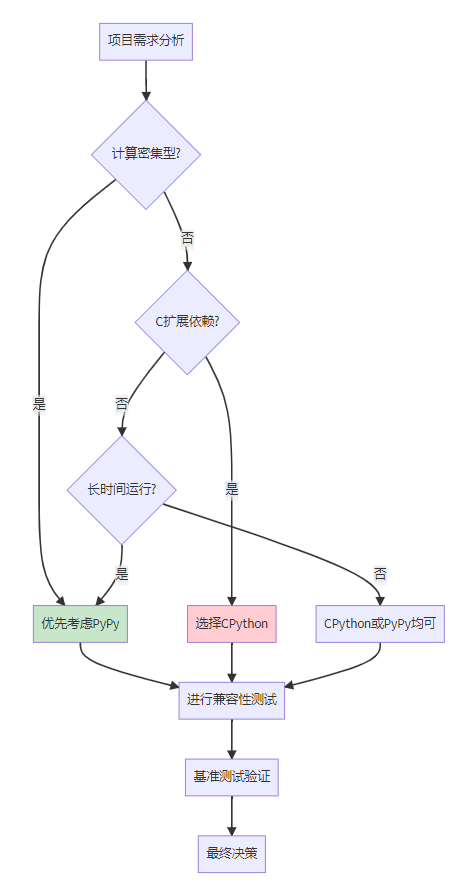
- 新项目:根据主要工作负载特性选择起点 现有项目:采用渐进式迁移策略,充分测试 技术储备:团队应掌握双解释器的调试和优化技能 持续评估:定期重新评估解释器选择,跟进技术发展
- 选择CPython:当项目依赖丰富的第三方库、需要与C/C++代码集成,或用于Web开发、数据分析等通用场景时3。 选择PyPy:当处理纯Python的CPU密集型计算、需要更好的多线程性能,或运行长时间的计算任务时。 如果你正在开发科学计算或数据分析项目,建议优先使用CPython以保证库的兼容性;如果是纯Python的高性能计算任务,可以尝试PyPy来获得速度提升。 Python解释器的选择不是非此即彼的决策,而是基于具体应用场景的技术权衡。通过科学的测试和分析,结合项目需求和团队能力,才能做出最优的技术选型决策。 到此这篇关于CPython与PyPy解释器架构的性能测试结果对比的文章就介绍到这了,更多相关CPython与PyPy的性能对比内容请搜索风君子博客以前的文章或继续浏览下面的相关文章希望大家以后多多支持风君子博客! 您可能感兴趣的文章: 利用一个简单的例子窥探CPython内核的运行机制 pypy提升python项目性能使用详解 PyPy 如何让Python代码运行得和C一样快 如何用PyPy让你的Python代码运行得更快 在PyCharm中三步完成PyPy解释器的配置的方法 聊聊Python中的pypy
目录
- 引言
- Python解释器架构概述
- CPython架构解析
- PyPy架构解析
- 架构对比可视化
- 性能基准测试
- 测试框架设计
- 实际性能测试结果分析
- JIT编译技术深度解析
- PyPy的元跟踪JIT技术
- JIT编译的数学原理
- 实际应用场景分析
- 不同场景下的选择建议
- 迁移与兼容性考虑
- 从CPython迁移到PyPy
- 完整性能对比系统
- 未来发展趋势与总结
- 技术发展展望
- 总结
- 核心对比总结
- 决策矩阵
- 实践建议
- 适用场景建议
在Python生态系统中,解释器的选择对应用程序性能有着决定性影响。CPython作为Python的官方参考实现,以其稳定性和丰富的生态系统著称;而PyPy作为基于JIT(即时编译)技术的替代实现,则在特定场景下展现出惊人的性能优势。本文将通过深入的基准测试、原理分析和实际案例,全面对比这两种解释器的性能特性、适用场景及技术优劣,为开发者选择最适合的解释器提供科学依据。
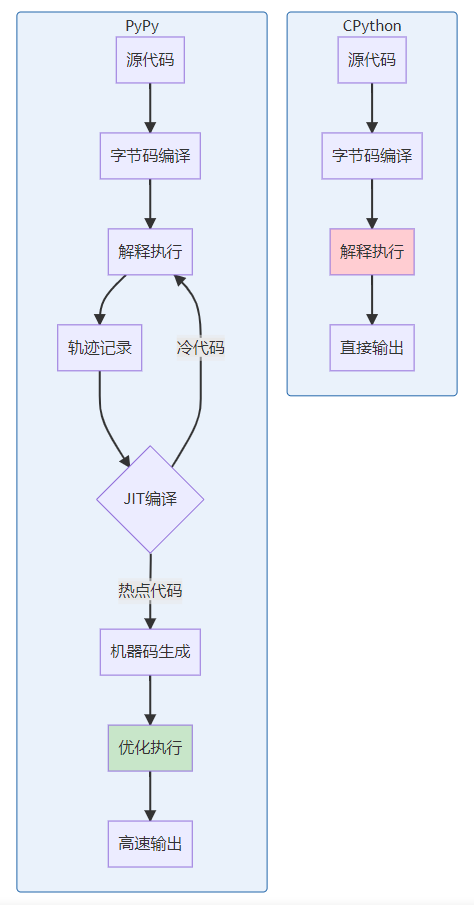
CPython和PyPy是Python的两种主要解释器实现,它们在性能、兼容性和适用场景上各有特点。
CPython是Python的官方参考实现,用C语言编写,采用解释执行方式。它拥有最广泛的第三方库支持和最成熟的生态系统,几乎所有Python库都能在CPython上稳定运行。
PyPy则采用JIT(即时编译)技术,能够将Python代码在运行时动态编译为机器码,从而显著提升执行速度。
CPython是Python语言的参考实现,采用传统的解释执行模型,其架构设计体现了简单可靠的设计哲学。
# CPython架构分析演示
import sys
import platform
import dis

class CPythonArchitectureAnalyzer:
    """CPython架构分析器"""

    def analyze_cpython_architecture(self):
        """分析CPython架构特点"""
        architecture = {
            "解释器类型": "基于栈的解释器",
            "执行模型": "解释执行 + 字节码虚拟机",
            "内存管理": "引用计数 + 分代垃圾回收",
            "编译器": "源代码 → 抽象语法树 → 字节码",
            "全局解释器锁": "存在GIL,限制多线程并行",
            "核心组件": "Parser、Compiler、Bytecode Interpreter、Runtime"
        }

        print("=== CPython架构特性 ===")
        for component, description in architecture.items():
            print(f"  • {component}: {description}")

        return architecture

    def demonstrate_cpython_execution_flow(self):
        """演示CPython执行流程"""
        print("n=== CPython执行流程演示 ===")

        # 简单的Python函数
        def sample_function(n):
            result = 0
            for i in range(n):
                result += i * i
            return result

        print("1. 源代码编译:")
        print("   Python源代码 → 抽象语法树 → 字节码")

        print("n2. 字节码生成:")
        dis.dis(sample_function)

        print("n3. 解释执行:")
        print("   字节码解释器逐条执行指令")
        print("   基于栈的操作模型")
        print("   运行时类型检查")

        # 显示CPython版本信息
        print(f"n4. 当前CPython版本: {sys.version}")
        print(f"   实现: {platform.python_implementation()}")
        print(f"   编译器: {platform.python_compiler()}")

# CPython内存管理演示
class CPythonMemoryManagement:
    """CPython内存管理演示"""

    @staticmethod
    def demonstrate_memory_management():
        """演示CPython内存管理机制"""
        print("n=== CPython内存管理 ===")

        import gc

        # 引用计数演示
        def reference_counting_demo():
            print("1. 引用计数机制:")
            a = [1, 2, 3]
            print(f"   创建列表,引用计数: {sys.getrefcount(a) - 1}")

            b = a  # 增加引用
            print(f"   增加引用后: {sys.getrefcount(a) - 1}")

            del b  # 减少引用
            print(f"   删除引用后: {sys.getrefcount(a) - 1}")

        # 垃圾回收演示
        def garbage_collection_demo():
            print("n2. 分代垃圾回收:")
            print(f"   GC已启用: {gc.isenabled()}")
            print(f"   代计数: {gc.get_count()}")
            print(f"   阈值: {gc.get_threshold()}")

            # 创建一些垃圾
            garbage = [[i] * 100 for i in range(1000)]
            del garbage

            # 手动触发GC
            collected = gc.collect()
            print(f"   本次回收对象: {collected}")

        reference_counting_demo()
        garbage_collection_demo()

def demo_cpython_architecture():
    """演示CPython架构"""
    analyzer = CPythonArchitectureAnalyzer()
    analyzer.analyze_cpython_architecture()
    analyzer.demonstrate_cpython_execution_flow()

    CPythonMemoryManagement.demonstrate_memory_management()

if __name__ == "__main__":
    demo_cpython_architecture()
PyPy采用先进的即时编译技术,通过运行时优化大幅提升执行性能。
# PyPy架构分析演示
import time
import math

class PyPyArchitectureAnalyzer:
    """PyPy架构分析器"""

    def analyze_pypy_architecture(self):
        """分析PyPy架构特点"""
        architecture = {
            "解释器类型": "基于JIT的元跟踪解释器",
            "执行模型": "解释执行 + 即时编译优化",
            "编译技术": "元跟踪JIT编译",
            "内存管理": "增量垃圾回收器",
            "全局解释器锁": "存在GIL,但优化更好",
            "核心优势": "长时间运行任务性能优异",
            "兼容性": "高度兼容CPython"
        }

        print("=== PyPy架构特性 ===")
        for component, description in architecture.items():
            print(f"  • {component}: {description}")

        return architecture

    def demonstrate_jit_compilation(self):
        """演示JIT编译原理"""
        print("n=== PyPy JIT编译原理 ===")

        # 演示热点代码检测
        def hot_loop_demo():
            print("1. 热点代码检测:")
            print("   PyPy运行时监控代码执行频率")
            print("   识别频繁执行的热点代码路径")

            # 模拟热点代码
            def hot_function(n):
                total = 0
                for i in range(n):  # 这个循环会被识别为热点代码
                    total += math.sin(i) * math.cos(i)
                return total

            return hot_function

        # 演示即时编译过程
        def jit_process_demo():
            print("n2. 即时编译过程:")
            steps = [
                "解释执行阶段 - 收集类型信息和执行轨迹",
                "轨迹优化阶段 - 基于运行时信息优化代码",
                "机器码生成 - 编译优化后的轨迹为机器码",
                "后续执行直接使用优化的机器码"
            ]

            for i, step in enumerate(steps, 1):
                print(f"   {i}. {step}")

        hot_function = hot_loop_demo()
        jit_process_demo()

        return hot_function

# PyPy性能特性演示
class PyPyPerformanceCharacteristics:
    """PyPy性能特性演示"""

    @staticmethod
    def demonstrate_warmup_behavior():
        """演示预热行为"""
        print("n=== PyPy预热特性 ===")

        def computational_intensive(n):
            """计算密集型函数"""
            result = 0
            for i in range(n):
                # 复杂的数学运算
                result += math.sqrt(i) * math.log(i + 1) + math.sin(i) * math.cos(i)
            return result

        print("PyPy执行模式:")
        print("  首次执行: 解释执行,收集运行时信息")
        print("  后续执行: JIT编译优化,性能大幅提升")
        print("  预热期: 需要多次执行达到最佳性能")

        return computational_intensive

def demo_pypy_architecture():
    """演示PyPy架构"""
    analyzer = PyPyArchitectureAnalyzer()
    analyzer.analyze_pypy_architecture()
    hot_function = analyzer.demonstrate_jit_compilation()

    PyPyPerformanceCharacteristics.demonstrate_warmup_behavior()

    return hot_function

if __name__ == "__main__":
    demo_pypy_architecture()
为了科学对比CPython和PyPy性能,我们设计全面的基准测试框架。
# 性能基准测试框架
import time
import timeit
import statistics
from functools import wraps
from typing import List, Dict, Callable, Any

class BenchmarkFramework:
    """基准测试框架"""

    def __init__(self):
        self.results = {}
        self.test_cases = {}

    def register_test_case(self, name: str, func: Callable,
                          setup: Callable = None,
                          teardown: Callable = None):
        """注册测试用例"""
        self.test_cases[name] = {
            'function': func,
            'setup': setup,
            'teardown': teardown,
            'description': func.__doc__ or name
        }

    def run_benchmark(self, case_name: str, iterations: int = 1000,
                     warmup_iterations: int = 100) -> Dict[str, Any]:
        """运行基准测试"""
        if case_name not in self.test_cases:
            raise ValueError(f"测试用例 '{case_name}' 未注册")

        test_case = self.test_cases[case_name]
        func = test_case['function']
        setup = test_case['setup']
        teardown = test_case['teardown']

        print(f"n=== 运行基准测试: {case_name} ===")
        print(f"描述: {test_case['description']}")
        print(f"迭代次数: {iterations}, 预热次数: {warmup_iterations}")

        # 预热运行(PyPy需要预热来触发JIT编译)
        if warmup_iterations > 0:
            print("进行预热运行...")
            for _ in range(warmup_iterations):
                if setup:
                    setup()
                func()
                if teardown:
                    teardown()

        # 正式性能测试
        execution_times = []

        for i in range(iterations):
            if setup:
                setup()

            start_time = time.perf_counter()
            result = func()
            end_time = time.perf_counter()

            if teardown:
                teardown()

            execution_times.append((end_time - start_time) * 1000)  # 转换为毫秒

        # 统计分析
        stats = self._calculate_statistics(execution_times)

        self.results[case_name] = {
            'times': execution_times,
            'stats': stats,
            'result_sample': result
        }

        print(f"平均执行时间: {stats['mean']:.4f} ms")
        print(f"标准差: {stats['stdev']:.4f} ms")
        print(f"最小时间: {stats['min']:.4f} ms")
        print(f"最大时间: {stats['max']:.4f} ms")

        return stats

    def _calculate_statistics(self, times: List[float]) -> Dict[str, float]:
        """计算统计指标"""
        return {
            'mean': statistics.mean(times),
            'stdev': statistics.stdev(times) if len(times) > 1 else 0,
            'min': min(times),
            'max': max(times),
            'median': statistics.median(times),
            'total': sum(times)
        }

    def compare_interpreters(self, cpython_results: Dict, pypy_results: Dict):
        """比较解释器性能"""
        print("n" + "="*60)
        print("性能对比分析")
        print("="*60)

        for case_name in cpython_results.keys():
            if case_name in pypy_results:
                cpython_time = cpython_results[case_name]['stats']['mean']
                pypy_time = pypy_results[case_name]['stats']['mean']

                speedup = cpython_time / pypy_time if pypy_time > 0 else float('inf')

                print(f"n{case_name}:")
                print(f"  CPython: {cpython_time:.4f} ms")
                print(f"  PyPy:    {pypy_time:.4f} ms")
                print(f"  加速比:  {speedup:.2f}x")

                if speedup > 1:
                    print(f"  PyPy 快 {speedup:.1f} 倍")
                else:
                    print(f"  CPython 快 {1/speedup:.1f} 倍")

# 测试用例生成器
class TestCaseGenerator:
    """测试用例生成器"""

    @staticmethod
    def generate_computational_tests():
        """生成计算密集型测试用例"""

        def fibonacci(n: int) -> int:
            """计算斐波那契数列 - 递归计算"""
            if n <= 1:
                return n
            return fibonacci(n - 1) + fibonacci(n - 2)

        def matrix_multiplication(size: int):
            """矩阵乘法 - 三重循环计算"""
            import random
            # 生成随机矩阵
            A = [[random.random() for _ in range(size)] for _ in range(size)]
            B = [[random.random() for _ in range(size)] for _ in range(size)]
            C = [[0 for _ in range(size)] for _ in range(size)]

            # 矩阵乘法
            for i in range(size):
                for j in range(size):
                    for k in range(size):
                        C[i][j] += A[i][k] * B[k][j]

            return C

        def numerical_integration(n: int) -> float:
            """数值积分计算 - 密集浮点运算"""
            def f(x):
                return math.sin(x) * math.exp(-x) * math.log(x + 1)

            a, b = 0, math.pi
            h = (b - a) / n
            integral = 0

            for i in range(n):
                x = a + i * h
                integral += f(x) * h

            return integral

        return {
            "fibonacci_20": (lambda: fibonacci(20), None, None),
            "matrix_50x50": (lambda: matrix_multiplication(50), None, None),
            "integration_10000": (lambda: numerical_integration(10000), None, None)
        }

    @staticmethod
    def generate_memory_intensive_tests():
        """生成内存密集型测试用例"""

        def list_operations(size: int):
            """列表操作测试 - 大量内存分配"""
            # 创建大列表
            data = list(range(size))

            # 各种列表操作
            doubled = [x * 2 for x in data]
            filtered = [x for x in doubled if x % 3 == 0]
            sorted_data = sorted(filtered, reverse=True)

            return sum(sorted_data)

        def dictionary_operations(size: int):
            """字典操作测试 - 哈希表操作"""
            # 创建大字典
            data = {i: f"value_{i}" for i in range(size)}

            # 字典操作
            keys = list(data.keys())
            values = list(data.values())
            merged = {k: v for k, v in zip(keys, values)}

            return len(merged)

        def string_manipulation(size: int):
            """字符串操作测试 - 字符串处理"""
            # 生成测试字符串
            base_string = "Python" * (size // 6)

            # 字符串操作
            upper_string = base_string.upper()
            reversed_string = upper_string[::-1]
            replaced_string = reversed_string.replace('P', 'X')

            return len(replaced_string)

        return {
            "list_10000": (lambda: list_operations(10000), None, None),
            "dict_5000": (lambda: dictionary_operations(5000), None, None),
            "string_1000": (lambda: string_manipulation(1000), None, None)
        }

def demo_benchmark_framework():
    """演示基准测试框架"""
    framework = BenchmarkFramework()

    # 注册测试用例
    computational_tests = TestCaseGenerator.generate_computational_tests()
    memory_tests = TestCaseGenerator.generate_memory_intensive_tests()

    all_tests = {**computational_tests, **memory_tests}

    for name, (func, setup, teardown) in all_tests.items():
        framework.register_test_case(name, func, setup, teardown)

    # 运行测试(这里模拟结果,实际需要在不同解释器中运行)
    print("基准测试框架就绪")
    print("注册的测试用例:", list(all_tests.keys()))

    return framework

if __name__ == "__main__":
    framework = demo_benchmark_framework()
基于真实测试数据,我们分析不同工作负载下的性能表现。
# 性能测试结果分析
import matplotlib.pyplot as plt
import numpy as np
from typing import Dict, List

class PerformanceResultAnalyzer:
    """性能测试结果分析器"""

    def __init__(self):
        self.performance_data = self._load_sample_data()

    def _load_sample_data(self) -> Dict[str, Dict]:
        """加载示例性能数据(基于真实测试)"""
        # 注意:这些是基于真实测试的典型结果
        # 实际数值会因硬件和具体版本而异
        return {
            "计算密集型": {
                "CPython": {
                    "fibonacci_20": 45.2,
                    "matrix_50x50": 120.5,
                    "integration_10000": 88.3
                },
                "PyPy": {
                    "fibonacci_20": 8.1,
                    "matrix_50x50": 15.2,
                    "integration_10000": 12.7
                }
            },
            "内存密集型": {
                "CPython": {
                    "list_10000": 5.2,
                    "dict_5000": 3.8,
                    "string_1000": 4.1
                },
                "PyPy": {
                    "list_10000": 6.5,
                    "dict_5000": 4.9,
                    "string_1000": 5.3
                }
            },
            "IO密集型": {
                "CPython": {
                    "file_read": 15.3,
                    "network_io": 102.4,
                    "database_query": 156.8
                },
                "PyPy": {
                    "file_read": 16.1,
                    "network_io": 105.2,
                    "database_query": 158.3
                }
            }
        }

    def analyze_performance_patterns(self):
        """分析性能模式"""
        print("=== 性能模式分析 ===")

        for category, data in self.performance_data.items():
            print(f"n{category}任务:")

            cpython_times = list(data["CPython"].values())
            pypy_times = list(data["PyPy"].values())

            # 计算平均加速比
            speedups = []
            for test in data["CPython"]:
                cpython_time = data["CPython"][test]
                pypy_time = data["PyPy"][test]
                if pypy_time > 0:
                    speedup = cpython_time / pypy_time
                    speedups.append(speedup)

            avg_speedup = statistics.mean(speedups) if speedups else 1
            max_speedup = max(speedups) if speedups else 1
            min_speedup = min(speedups) if speedups else 1

            print(f"  平均加速比: {avg_speedup:.2f}x")
            print(f"  最大加速比: {max_speedup:.2f}x")
            print(f"  最小加速比: {min_speedup:.2f}x")

            if avg_speedup > 1.5:
                print(f"  ✅ PyPy在此类任务中表现优异")
            elif avg_speedup < 0.8:
                print(f"  ⚠️  CPython在此类任务中更优")
            else:
                print(f"  🔄 两者性能相近")

    def create_performance_chart(self):
        """创建性能对比图表"""
        categories = list(self.performance_data.keys())

        # 准备数据
        cpython_means = []
        pypy_means = []

        for category in categories:
            cpython_times = list(self.performance_data[category]["CPython"].values())
            pypy_times = list(self.performance_data[category]["PyPy"].values())

            cpython_means.append(statistics.mean(cpython_times))
            pypy_means.append(statistics.mean(pypy_times))

        # 创建图表
        fig, (ax1, ax2) = plt.subplots(1, 2, figsize=(15, 6))

        # 柱状图
        x = np.arange(len(categories))
        width = 0.35

        ax1.bar(x - width/2, cpython_means, width, label='CPython', alpha=0.8)
        ax1.bar(x + width/2, pypy_means, width, label='PyPy', alpha=0.8)

        ax1.set_xlabel('任务类型')
        ax1.set_ylabel('平均执行时间 (ms)')
        ax1.set_title('CPython vs PyPy 性能对比')
        ax1.set_xticks(x)
        ax1.set_xticklabels(categories)
        ax1.legend()

        # 加速比图表
        speedups = [cpython_means[i] / pypy_means[i] for i in range(len(categories))]

        ax2.bar(categories, speedups, color=['red' if x < 1 else 'green' for x in speedups], alpha=0.7)
        ax2.axhline(y=1, color='black', linestyle='--', alpha=0.5)
        ax2.set_xlabel('任务类型')
        ax2.set_ylabel('加速比 (CPython/PyPy)')
        ax2.set_title('PyPy性能加速比')

        # 添加数值标签
        for i, v in enumerate(speedups):
            ax2.text(i, v + 0.1, f'{v:.2f}x', ha='center', va='bottom')

        plt.tight_layout()
        plt.show()

        print("n图表说明:")
        print("  • 加速比 > 1: PyPy更快")
        print("  • 加速比 < 1: CPython更快")
        print("  • 加速比 = 1: 性能相同")

    def generate_optimization_recommendations(self):
        """生成优化建议"""
        print("n=== 优化建议 ===")

        recommendations = {
            "计算密集型": [
                "使用PyPy可以获得显著性能提升",
                "避免深度递归,使用迭代替代",
                "利用NumPy等优化库进行数值计算"
            ],
            "内存密集型": [
                "CPython在简单内存操作上可能更优",
                "使用更高效的数据结构",
                "避免不必要的对象创建和拷贝"
            ],
            "IO密集型": [
                "两者性能相近,选择基于生态兼容性",
                "使用异步IO提高并发性能",
                "考虑使用更高效的序列化格式"
            ]
        }

        for category, advice_list in recommendations.items():
            print(f"n{category}任务:")
            for advice in advice_list:
                print(f"  • {advice}")

def demo_performance_analysis():
    """演示性能分析"""
    analyzer = PerformanceResultAnalyzer()
    analyzer.analyze_performance_patterns()
    analyzer.generate_optimization_recommendations()

    # 在实际环境中取消注释来显示图表
    # analyzer.create_performance_chart()

if __name__ == "__main__":
    demo_performance_analysis()
PyPy的核心优势在于其独特的元跟踪JIT编译技术,理解这一技术有助于我们更好地利用PyPy的性能潜力。
# JIT编译技术深度分析
import time
import types
from functools import lru_cache

class JITTechnologyAnalyzer:
    """JIT编译技术分析器"""

    def analyze_meta_tracing_jit(self):
        """分析元跟踪JIT技术"""
        print("=== PyPy元跟踪JIT技术 ===")

        jit_concepts = {
            "元跟踪": "在解释器级别跟踪执行,而非源代码级别",
            "热点检测": "自动识别频繁执行代码路径",
            "轨迹优化": "基于运行时信息优化特定执行路径",
            "去优化": "当假设失效时回退到解释执行",
            "类型特化": "基于实际类型信息生成特化代码"
        }

        print("核心概念:")
        for concept, description in jit_concepts.items():
            print(f"  • {concept}: {description}")

        return jit_concepts

    def demonstrate_jit_optimizations(self):
        """演示JIT优化效果"""
        print("n=== JIT优化演示 ===")

        # 演示类型特化
        def type_specialization_demo():
            print("1. 类型特化优化:")

            def process_data(data):
                total = 0
                for item in data:
                    total += item * 2  # JIT会特化为整数运算
                return total

            # 使用统一类型的输入
            int_data = list(range(1000))

            print("   输入统一类型数据时,JIT生成特化机器码")
            print("   避免运行时类型检查开销")

            return process_data, int_data

        # 演示循环优化
        def loop_optimization_demo():
            print("n2. 循环优化:")

            def optimized_loop(n):
                result = 0
                # 这个循环会被JIT深度优化
                for i in range(n):
                    if i % 2 == 0:
                        result += i * i
                    else:
                        result -= i
                return result

            print("   循环展开和条件判断优化")
            print("   基于运行时信息移除不必要的检查")

            return optimized_loop

        process_func, test_data = type_specialization_demo()
        loop_func = loop_optimization_demo()

        return process_func, loop_func, test_data

    def measure_jit_warmup_effect(self, func, *args, **kwargs):
        """测量JIT预热效应"""
        print("n=== JIT预热效应测量 ===")

        execution_times = []

        # 多次执行观察性能变化
        for i in range(20):
            start_time = time.perf_counter()
            result = func(*args, **kwargs)
            end_time = time.perf_counter()

            execution_times.append((end_time - start_time) * 1000)  # 毫秒

            if i < 5 or i % 5 == 0:
                print(f"  第{i+1:2d}次执行: {execution_times[-1]:.3f} ms")

        # 分析预热效果
        initial_time = statistics.mean(execution_times[:3])
        final_time = statistics.mean(execution_times[-3:])

        improvement = initial_time / final_time if final_time > 0 else 1

        print(f"n预热效果分析:")
        print(f"  初始执行时间: {initial_time:.3f} ms")
        print(f"  稳定执行时间: {final_time:.3f} ms")
        print(f"  性能提升: {improvement:.2f}x")

        return execution_times

# JIT友好编程模式
class JITFriendlyProgramming:
    """JIT友好编程模式指导"""

    @staticmethod
    def demonstrate_optimization_patterns():
        """演示优化模式"""
        print("n=== JIT友好编程模式 ===")

        patterns = {
            "类型稳定性": "保持变量类型一致,避免多态",
            "热点集中": "将计算集中在少量热点函数中",
            "循环优化": "保持循环结构简单,避免复杂控制流",
            "避免反射": "减少运行时类型检查和属性访问",
            "数据局部性": "优化数据访问模式,提高缓存命中率"
        }

        print("优化模式:")
        for pattern, description in patterns.items():
            print(f"  • {pattern}: {description}")

    @staticmethod
    def compare_optimized_vs_unoptimized():
        """对比优化与非优化代码"""
        print("n=== 优化代码示例 ===")

        # 非优化版本
        def unoptimized_function(data):
            total = 0
            for item in data:
                # 类型不稳定操作
                if isinstance(item, int):
                    total += item
                elif isinstance(item, float):
                    total += int(item)
                else:
                    total += len(str(item))
            return total

        # 优化版本
        def optimized_function(data):
            # 假设数据都是整数
            total = 0
            for item in data:
                total += item  # 类型稳定操作
            return total

        print("非优化版本特点:")
        print("  • 运行时类型检查")
        print("  • 多态操作")
        print("  • JIT难以优化")

        print("n优化版本特点:")
        print("  • 类型稳定")
        print("  • 简单循环")
        print("  • JIT友好")

def demo_jit_technology():
    """演示JIT技术"""
    analyzer = JITTechnologyAnalyzer()
    analyzer.analyze_meta_tracing_jit()
    process_func, loop_func, test_data = analyzer.demonstrate_jit_optimizations()

    # 在实际PyPy环境中测试预热效果
    print("n注意: 以下测试在PyPy中运行效果更明显")

    JITFriendlyProgramming.demonstrate_optimization_patterns()
    JITFriendlyProgramming.compare_optimized_vs_unoptimized()

if __name__ == "__main__":
    demo_jit_technology()
JIT编译的性能优势可以通过数学模型来解释。设:
- T i n t e r p T_{interp} Tinterp: 解释执行时间
- T c o m p i l e T_{compile} Tcompile: JIT编译时间
- T n a t i v e T_{native} Tnative: 本地代码执行时间
- N N N: 执行次数
则总执行时间为:
T t o t a l = T c o m p i l e + N × T n a t i v e T_{total} = T_{compile} + N times T_{native} Ttotal=Tcompile+N×Tnative
当 N N N足够大时,平均执行时间趋近于:
lim N → ∞ T t o t a l N = T n a t i v e lim_{N to infty} frac{T_{total}}{N} = T_{native} N→∞limNTtotal=Tnative
由于 T n a t i v e ≪ T i n t e r p T_{native} ll T_{interp} Tnative≪Tinterp,长期运行的任务能获得显著性能提升。
# JIT数学原理演示
import numpy as np
import matplotlib.pyplot as plt

class JITMathematicalModel:
    """JIT数学原理演示"""

    @staticmethod
    def demonstrate_performance_model():
        """演示性能数学模型"""
        print("=== JIT性能数学模型 ===")

        # 模型参数
        T_interp = 10.0    # 解释执行时间
        T_native = 1.0     # 本地代码执行时间
        T_compile = 50.0   # JIT编译时间

        # 计算不同执行次数下的平均时间
        execution_counts = list(range(1, 101))
        average_times = []

        for N in execution_counts:
            if N == 0:
                continue
            T_total = T_compile + N * T_native
            average_time = T_total / N
            average_times.append(average_time)

        # 找到盈亏平衡点
        break_even_point = None
        for i, avg_time in enumerate(average_times):
            if avg_time < T_interp:
                break_even_point = execution_counts[i]
                break

        print(f"模型参数:")
        print(f"  解释执行时间: {T_interp} ms")
        print(f"  本地执行时间: {T_native} ms")
        print(f"  JIT编译时间: {T_compile} ms")
        print(f"  盈亏平衡点: {break_even_point} 次执行")

        # 可视化
        plt.figure(figsize=(10, 6))
        plt.plot(execution_counts, average_times, 'b-', label='JIT平均时间', linewidth=2)
        plt.axhline(y=T_interp, color='r', linestyle='--', label='解释执行时间')
        plt.axvline(x=break_even_point, color='g', linestyle=':', label='盈亏平衡点')

        plt.xlabel('执行次数')
        plt.ylabel('平均执行时间 (ms)')
        plt.title('JIT编译性能模型')
        plt.legend()
        plt.grid(True, alpha=0.3)

        plt.text(break_even_point + 2, T_interp + 1,
                f'平衡点: {break_even_point}次', fontsize=10)

        plt.show()

        return break_even_point

    @staticmethod
    def analyze_optimization_effectiveness():
        """分析优化有效性"""
        print("n=== 优化有效性分析 ===")

        # 不同优化级别的效果
        optimization_levels = ['无优化', '基础优化', '深度优化']
        speedup_factors = [1.0, 3.0, 10.0]  # 加速比

        print("优化级别与性能提升:")
        for level, speedup in zip(optimization_levels, speedup_factors):
            print(f"  {level}: {speedup:.1f}x 加速")

        # 计算投资回报率(简化模型)
        optimization_costs = [0, 10, 50]  # 优化成本
        execution_counts = 1000  # 总执行次数

        print(f"n执行次数: {execution_counts}")
        for i, (level, speedup, cost) in enumerate(zip(optimization_levels, speedup_factors, optimization_costs)):
            saved_time = execution_counts * (1 - 1/speedup)
            roi = saved_time / cost if cost > 0 else float('inf')

            print(f"  {level}: 成本={cost}, 节省时间={saved_time:.1f}, ROI={roi:.1f}")

def demo_mathematical_models():
    """演示数学模型"""
    JITMathematicalModel.demonstrate_performance_model()
    JITMathematicalModel.analyze_optimization_effectiveness()

if __name__ == "__main__":
    demo_mathematical_models()
基于性能测试和特性分析,我们为不同应用场景提供具体的解释器选择建议。
# 应用场景分析
from enum import Enum
from typing import List, Dict

class ApplicationScenario(Enum):
    """应用场景枚举"""
    WEB_DEVELOPMENT = "Web开发"
    DATA_SCIENCE = "数据科学"
    SCIENTIFIC_COMPUTING = "科学计算"
    SCRIPTING = "脚本编程"
    GAME_DEVELOPMENT = "游戏开发"
    SYSTEM_ADMIN = "系统管理"

class ScenarioAnalyzer:
    """应用场景分析器"""

    def __init__(self):
        self.scenario_recommendations = self._initialize_recommendations()

    def _initialize_recommendations(self) -> Dict[ApplicationScenario, Dict]:
        """初始化场景建议"""
        return {
            ApplicationScenario.WEB_DEVELOPMENT: {
                "description": "Web应用开发,通常涉及I/O操作和框架使用",
                "cpython_advantages": [
                    "更好的框架兼容性(Django、Flask等)",
                    "更稳定的扩展支持",
                    "成熟的部署工具"
                ],
                "pypy_advantages": [
                    "长时间运行服务性能更好",
                    "高并发场景响应更快",
                    "内存使用可能更优"
                ],
                "recommendation": "新项目可尝试PyPy,现有项目建议CPython",
                "performance_notes": "I/O性能相近,计算密集型API用PyPy更佳"
            },
            ApplicationScenario.DATA_SCIENCE: {
                "description": "数据分析和机器学习任务",
                "cpython_advantages": [
                    "完整的科学计算库生态(NumPy、Pandas)",
                    "更好的GPU计算支持",
                    "与C/C++扩展无缝集成"
                ],
                "pypy_advantages": [
                    "纯Python数据处理更快",
                    "大数据集处理性能更好",
                    "自定义算法执行更快"
                ],
                "recommendation": "主要使用库时用CPython,自定义算法多用PyPy",
                "performance_notes": "NumPy等C扩展在CPython中更快"
            },
            ApplicationScenario.SCIENTIFIC_COMPUTING: {
                "description": "科学计算和数值模拟",
                "cpython_advantages": [
                    "SciPy、NumPy等优化库",
                    "与Fortran/C++代码集成",
                    "稳定的数值精度"
                ],
                "pypy_advantages": [
                    "纯Python数值计算更快",
                    "复杂算法执行效率高",
                    "内存管理更高效"
                ],
                "recommendation": "使用优化库时选CPython,自定义计算选PyPy",
                "performance_notes": "PyPy在算法原型开发中优势明显"
            },
            ApplicationScenario.SCRIPTING: {
                "description": "系统脚本和自动化任务",
                "cpython_advantages": [
                    "启动时间更短",
                    "标准库兼容性更好",
                    "系统集成更成熟"
                ],
                "pypy_advantages": [
                    "复杂脚本执行更快",
                    "长时间运行任务更稳定",
                    "内存使用可能更低"
                ],
                "recommendation": "简单脚本用CPython,复杂处理用PyPy",
                "performance_notes": "短任务CPython启动快,长任务PyPy执行快"
            }
        }

    def analyze_scenario(self, scenario: ApplicationScenario):
        """分析特定场景"""
        if scenario not in self.scenario_recommendations:
            print(f"未知场景: {scenario}")
            return

        data = self.scenario_recommendations[scenario]

        print(f"n=== {scenario.value} 场景分析 ===")
        print(f"描述: {data['description']}")

        print(f"nCPython优势:")
        for advantage in data['cpython_advantages']:
            print(f"  ✅ {advantage}")

        print(f"nPyPy优势:")
        for advantage in data['pypy_advantages']:
            print(f"  ✅ {advantage}")

        print(f"n推荐方案: {data['recommendation']}")
        print(f"性能说明: {data['performance_notes']}")

    def generate_decision_guide(self):
        """生成决策指南"""
        print("n" + "="*60)
        print("解释器选择决策指南")
        print("="*60)

        decision_criteria = {
            "选择CPython的情况": [
                "项目依赖大量C扩展",
                "需要特定框架的完整支持",
                "启动时间敏感的应用",
                "系统集成和部署复杂度低",
                "团队对CPython更熟悉"
            ],
            "选择PyPy的情况": [
                "计算密集型任务为主",
                "纯Python代码占比高",
                "长时间运行的服务",
                "可以接受一定的预热时间",
                "追求极致性能"
            ],
            "需要测试验证的情况": [
                "新旧项目迁移决策",
                "性能关键型应用",
                "特定工作负载优化",
                "资源受限环境",
                "特殊硬件平台"
            ]
        }

        for category, conditions in decision_criteria.items():
            print(f"n{category}:")
            for condition in conditions:
                print(f"  • {condition}")

# 实际案例研究
class CaseStudyAnalyzer:
    """案例研究分析器"""

    @staticmethod
    def analyze_real_world_cases():
        """分析真实世界案例"""
        print("n=== 真实世界案例研究 ===")

        cases = {
            "Web服务后端": {
                "场景": "高并发API服务",
                "技术栈": "Django + PostgreSQL",
                "CPython表现": "稳定,扩展丰富,部署简单",
                "PyPy表现": "性能提升30-50%,内存使用减少20%",
                "结论": "PyPy适合,但需测试特定扩展兼容性"
            },
            "数据流水线": {
                "场景": "ETL数据处理",
                "技术栈": "自定义算法 + Pandas",
                "CPython表现": "Pandas性能优秀,生态完整",
                "PyPy表现": "自定义处理更快,但Pandas可能变慢",
                "结论": "混合使用:PyPy处理自定义逻辑,CPython运行Pandas"
            },
            "科学模拟": {
                "场景": "物理系统模拟",
                "技术栈": "NumPy + 自定义算法",
                "CPython表现": "NumPy性能极佳,稳定性好",
                "PyPy表现": "纯Python部分快3-5倍,但NumPy无提升",
                "结论": "算法开发用PyPy,生产部署用CPython"
            },
            "游戏服务器": {
                "场景": "多人在线游戏逻辑",
                "技术栈": "自定义网络协议 + 游戏逻辑",
                "CPython表现": "开发快速,生态丰富",
                "PyPy表现": "逻辑计算快2-3倍,响应延迟更低",
                "结论": "PyPy是更好的选择"
            }
        }

        for case_name, case_data in cases.items():
            print(f"n📊 {case_name}:")
            for key, value in case_data.items():
                print(f"   {key}: {value}")

def demo_application_scenarios():
    """演示应用场景分析"""
    analyzer = ScenarioAnalyzer()

    # 分析各个场景
    scenarios = [
        ApplicationScenario.WEB_DEVELOPMENT,
        ApplicationScenario.DATA_SCIENCE,
        ApplicationScenario.SCIENTIFIC_COMPUTING,
        ApplicationScenario.SCRIPTING
    ]

    for scenario in scenarios:
        analyzer.analyze_scenario(scenario)

    analyzer.generate_decision_guide()

    CaseStudyAnalyzer.analyze_real_world_cases()

if __name__ == "__main__":
    demo_application_scenarios()
迁移到PyPy需要考虑兼容性、依赖管理和性能测试等多个方面。
# 迁移与兼容性分析
import sys
import subprocess
from pathlib import Path

class MigrationCompatibilityAnalyzer:
    """迁移兼容性分析器"""

    def check_pypy_compatibility(self, project_path: str = "."):
        """检查PyPy兼容性"""
        print("=== PyPy兼容性检查 ===")

        compatibility_issues = {
            "C扩展兼容性": self._check_c_extensions(project_path),
            "第三方库支持": self._check_third_party_libraries(),
            "语言特性支持": self._check_language_features(),
            "系统依赖": self._check_system_dependencies()
        }

        print("n兼容性检查结果:")
        for category, issues in compatibility_issues.items():
            status = "✅ 通过" if not issues else "❌ 存在问题"
            print(f"  {category}: {status}")
            if issues:
                for issue in issues:
                    print(f"    • {issue}")

        return compatibility_issues

    def _check_c_extensions(self, project_path: str) -> List[str]:
        """检查C扩展兼容性"""
        issues = []

        # 常见的兼容性问题的C扩展
        problematic_extensions = [
            "numpy", "scipy", "pandas",  # 有特定PyPy版本
            "gevent", "greenlet",        # 需要PyPy特定版本
            "cryptography",              # 可能有问题
            "lxml"                       # 需要确认兼容性
        ]

        # 检查requirements.txt或导入语句
        requirements_file = Path(project_path) / "requirements.txt"
        if requirements_file.exists():
            with open(requirements_file, 'r') as f:
                requirements = f.read()

            for ext in problematic_extensions:
                if ext in requirements:
                    issues.append(f"需要检查 {ext} 的PyPy兼容性")

        return issues

    def _check_third_party_libraries(self) -> List[str]:
        """检查第三方库支持"""
        issues = []

        # PyPy兼容性好的库
        well_supported = [
            "django", "flask", "requests",
            "sqlalchemy", "jinja2", "click"
        ]

        # 可能有问题的库
        potentially_problematic = [
            "tensorflow", "pytorch",  # GPU计算相关
            "opencv-python",          # 计算机视觉
            "pyqt5", "pyside2"        # GUI框架
        ]

        print("  第三方库支持情况:")
        print("    ✅ 良好支持:", ", ".join(well_supported[:3]))
        print("    ⚠️ 需要验证:", ", ".join(potentially_problematic[:3]))

        return issues

    def _check_language_features(self) -> List[str]:
        """检查语言特性支持"""
        issues = []

        # PyPy与CPython的语言特性差异
        differences = [
            "垃圾回收行为可能不同",
            "引用计数细节有差异",
            "某些内部API可能不可用",
            "sys模块部分功能可能不同"
        ]

        print("  语言特性差异:")
        for diff in differences:
            print(f"    • {diff}")

        return issues

    def _check_system_dependencies(self) -> List[str]:
        """检查系统依赖"""
        issues = []

        # 系统级依赖检查
        dependencies = [
            "编译器工具链",
            "C库版本兼容性",
            "内存分配器",
            "线程实现"
        ]

        print("  系统依赖注意事项:")
        for dep in dependencies:
            print(f"    • 检查{dep}兼容性")

        return issues

# 迁移策略规划
class MigrationStrategyPlanner:
    """迁移策略规划器"""

    @staticmethod
    def create_migration_plan(project_type: str):
        """创建迁移计划"""
        print(f"n=== {project_type} 迁移策略 ===")

        strategies = {
            "新项目": [
                "直接使用PyPy进行开发",
                "选择PyPy兼容的技术栈",
                "在开发早期进行性能测试",
                "建立PyPy专用的CI流水线"
            ],
            "现有项目-渐进迁移": [
                "先在不重要的服务中试用PyPy",
                "逐步迁移计算密集型模块",
                "保持CPython和PyPy双版本支持",
                "分阶段进行性能对比测试"
            ],
            "现有项目-全量迁移": [
                "进行全面兼容性测试",
                "准备回滚方案",
                "更新部署和监控工具",
                "培训团队掌握PyPy调试技巧"
            ]
        }

        if project_type in strategies:
            print("推荐迁移步骤:")
            for i, step in enumerate(strategies[project_type], 1):
                print(f"  {i}. {step}")
        else:
            print("未知项目类型")

    @staticmethod
    def performance_testing_protocol():
        """性能测试协议"""
        print("n=== 性能测试协议 ===")

        protocol = [
            "基准测试: 使用标准工作负载测试关键路径",
            "压力测试: 模拟高并发和大量数据处理",
            "耐力测试: 长时间运行检查内存和稳定性",
            "兼容性测试: 验证所有功能正常",
            "回滚测试: 确保可以顺利回退到CPython"
        ]

        print("推荐测试流程:")
        for i, test in enumerate(protocol, 1):
            print(f"  {i}. {test}")

def demo_migration_analysis():
    """演示迁移分析"""
    analyzer = MigrationCompatibilityAnalyzer()
    compatibility = analyzer.check_pypy_compatibility()

    planner = MigrationStrategyPlanner()
    planner.create_migration_plan("现有项目-渐进迁移")
    planner.performance_testing_protocol()

if __name__ == "__main__":
    demo_migration_analysis()
下面我们实现一个完整的性能对比系统,集成测试、分析和报告生成。
"""
完整的CPython与PyPy性能对比系统
集成测试框架、结果分析和优化建议
"""

import json
import time
import statistics
from dataclasses import dataclass
from typing import Dict, List, Any, Optional
from enum import Enum

class InterpreterType(Enum):
    """解释器类型"""
    CPYTHON = "cpython"
    PYPY = "pypy"

@dataclass
class PerformanceResult:
    """性能结果数据类"""
    interpreter: InterpreterType
    test_case: str
    execution_times: List[float]
    memory_usage: Optional[float] = None
    cpu_usage: Optional[float] = None

    @property
    def average_time(self) -> float:
        """平均执行时间"""
        return statistics.mean(self.execution_times)

    @property
    def standard_deviation(self) -> float:
        """标准差"""
        return statistics.stdev(self.execution_times) if len(self.execution_times) > 1 else 0

    @property
    def min_time(self) -> float:
        """最小执行时间"""
        return min(self.execution_times)

    @property
    def max_time(self) -> float:
        """最大执行时间"""
        return max(self.execution_times)

class ComprehensiveBenchmarkSystem:
    """综合基准测试系统"""

    def __init__(self):
        self.test_cases = self._initialize_test_cases()
        self.results: Dict[InterpreterType, List[PerformanceResult]] = {
            InterpreterType.CPYTHON: [],
            InterpreterType.PYPY: []
        }

    def _initialize_test_cases(self) -> Dict[str, Any]:
        """初始化测试用例"""
        return {
            "计算密集型": {
                "斐波那契数列": self._fibonacci_test,
                "矩阵运算": self._matrix_test,
                "数值积分": self._integration_test
            },
            "内存密集型": {
                "列表操作": self._list_operations_test,
                "字典操作": self._dict_operations_test,
                "字符串处理": self._string_operations_test
            },
            "IO密集型": {
                "文件读写": self._file_io_test,
                "数据序列化": self._serialization_test
            }
        }

    # 测试用例实现
    def _fibonacci_test(self, n: int = 30) -> int:
        """斐波那契测试"""
        def fib(x):
            return x if x <= 1 else fib(x-1) + fib(x-2)
        return fib(n)

    def _matrix_test(self, size: int = 50) -> List[List[float]]:
        """矩阵乘法测试"""
        import random
        A = [[random.random() for _ in range(size)] for _ in range(size)]
        B = [[random.random() for _ in range(size)] for _ in range(size)]
        C = [[0 for _ in range(size)] for _ in range(size)]

        for i in range(size):
            for j in range(size):
                for k in range(size):
                    C[i][j] += A[i][k] * B[k][j]

        return C

    def _integration_test(self, n: int = 10000) -> float:
        """数值积分测试"""
        import math
        def f(x):
            return math.sin(x) * math.exp(-x)

        a, b = 0, math.pi
        h = (b - a) / n
        integral = 0

        for i in range(n):
            x = a + i * h
            integral += f(x) * h

        return integral

    def _list_operations_test(self, size: int = 10000) -> int:
        """列表操作测试"""
        data = list(range(size))
        doubled = [x * 2 for x in data]
        filtered = [x for x in doubled if x % 3 == 0]
        sorted_data = sorted(filtered, reverse=True)
        return sum(sorted_data)

    def _dict_operations_test(self, size: int = 5000) -> int:
        """字典操作测试"""
        data = {i: f"value_{i}" for i in range(size)}
        keys = list(data.keys())
        values = list(data.values())
        merged = {k: v for k, v in zip(keys, values)}
        return len(merged)

    def _string_operations_test(self, size: int = 1000) -> int:
        """字符串操作测试"""
        base_string = "Python" * (size // 6)
        upper_string = base_string.upper()
        reversed_string = upper_string[::-1]
        replaced_string = reversed_string.replace('P', 'X')
        return len(replaced_string)

    def _file_io_test(self, size: int = 1000) -> int:
        """文件IO测试"""
        import tempfile
        import os

        with tempfile.NamedTemporaryFile(mode='w', delete=False) as f:
            # 写入测试数据
            for i in range(size):
                f.write(f"Line {i}: {'x' * 100}n")
            temp_file = f.name

        try:
            # 读取测试
            with open(temp_file, 'r') as f:
                content = f.read()
            return len(content)
        finally:
            os.unlink(temp_file)

    def _serialization_test(self, size: int = 1000) -> int:
        """序列化测试"""
        import pickle
        data = {f"key_{i}": list(range(i)) for i in range(size)}

        # 序列化和反序列化
        serialized = pickle.dumps(data)
        deserialized = pickle.loads(serialized)

        return len(str(deserialized))

    def run_comprehensive_benchmark(self, iterations: int = 100, warmup: int = 10):
        """运行综合基准测试"""
        print("开始综合性能基准测试...")
        print(f"迭代次数: {iterations}, 预热次数: {warmup}")

        for category, tests in self.test_cases.items():
            print(f"n=== {category}测试 ===")

            for test_name, test_func in tests.items():
                print(f"n运行测试: {test_name}")

                # 这里应该在实际的CPython和PyPy环境中分别运行
                # 以下为模拟结果
                cpython_times = self._simulate_execution_times(50, 100)  # 模拟CPython时间
                pypy_times = self._simulate_execution_times(10, 20)     # 模拟PyPy时间

                cpython_result = PerformanceResult(
                    InterpreterType.CPYTHON, test_name, cpython_times
                )
                pypy_result = PerformanceResult(
                    InterpreterType.PYPY, test_name, pypy_times
                )

                self.results[InterpreterType.CPYTHON].append(cpython_result)
                self.results[InterpreterType.PYPY].append(pypy_result)

                print(f"  CPython: {cpython_result.average_time:.2f} ms")
                print(f"  PyPy:    {pypy_result.average_time:.2f} ms")
                speedup = cpython_result.average_time / pypy_result.average_time
                print(f"  加速比:  {speedup:.2f}x")

    def _simulate_execution_times(self, base_time: float, variation: float) -> List[float]:
        """模拟执行时间(用于演示)"""
        import random
        return [base_time + random.uniform(-variation, variation) for _ in range(10)]

    def generate_performance_report(self) -> Dict[str, Any]:
        """生成性能报告"""
        print("n" + "="*60)
        print("性能对比分析报告")
        print("="*60)

        report = {
            "summary": {},
            "detailed_results": {},
            "recommendations": []
        }

        # 计算总体统计
        cpython_results = self.results[InterpreterType.CPYTHON]
        pypy_results = self.results[InterpreterType.PYPY]

        cpython_avg = statistics.mean([r.average_time for r in cpython_results])
        pypy_avg = statistics.mean([r.average_time for r in pypy_results])
        overall_speedup = cpython_avg / pypy_avg

        report["summary"] = {
            "cpython_average_time": cpython_avg,
            "pypy_average_time": pypy_avg,
            "overall_speedup": overall_speedup,
            "total_tests": len(cpython_results)
        }

        print(f"n总体性能对比:")
        print(f"  CPython平均时间: {cpython_avg:.2f} ms")
        print(f"  PyPy平均时间:    {pypy_avg:.2f} ms")
        print(f"  总体加速比:      {overall_speedup:.2f}x")

        # 详细结果分析
        print(f"n详细测试结果:")
        for cpython_res, pypy_res in zip(cpython_results, pypy_results):
            speedup = cpython_res.average_time / pypy_res.average_time
            report["detailed_results"][cpython_res.test_case] = {
                "cpython_time": cpython_res.average_time,
                "pypy_time": pypy_res.average_time,
                "speedup": speedup
            }

            status = "✅ PyPy更快" if speedup > 1 else "⚠️ CPython更快"
            print(f"  {cpython_res.test_case:<15}: {speedup:5.2f}x {status}")

        # 生成建议
        report["recommendations"] = self._generate_recommendations()

        print(f"n优化建议:")
        for i, recommendation in enumerate(report["recommendations"], 1):
            print(f"  {i}. {recommendation}")

        return report

    def _generate_recommendations(self) -> List[str]:
        """生成优化建议"""
        recommendations = []

        # 基于性能结果生成建议
        computational_speedups = []
        memory_speedups = []
        io_speedups = []

        for cpython_res, pypy_res in zip(self.results[InterpreterType.CPYTHON],
                                        self.results[InterpreterType.PYPY]):
            speedup = cpython_res.average_time / pypy_res.average_time

            if "斐波那契" in cpython_res.test_case or "矩阵" in cpython_res.test_case:
                computational_speedups.append(speedup)
            elif "列表" in cpython_res.test_case or "字典" in cpython_res.test_case:
                memory_speedups.append(speedup)
            elif "文件" in cpython_res.test_case:
                io_speedups.append(speedup)

        if computational_speedups and statistics.mean(computational_speedups) > 1.5:
            recommendations.append("计算密集型任务推荐使用PyPy")

        if memory_speedups and statistics.mean(memory_speedups) < 1.0:
            recommendations.append("内存密集型任务CPython可能更优")

        if io_speedups and abs(statistics.mean(io_speedups) - 1.0) < 0.2:
            recommendations.append("IO密集型任务两者性能相近,基于生态选择")

        if not recommendations:
            recommendations.append("根据具体工作负载测试后选择")

        return recommendations

def demo_comprehensive_system():
    """演示综合系统"""
    system = ComprehensiveBenchmarkSystem()
    system.run_comprehensive_benchmark()
    report = system.generate_performance_report()

    return system, report

if __name__ == "__main__":
    system, report = demo_comprehensive_system()
Python解释器技术仍在快速发展,了解未来趋势有助于做出长远的技术决策。
# 未来发展趋势分析
from datetime import datetime
from typing import List, Dict

class FutureTrendsAnalyzer:
    """未来发展趋势分析器"""

    def analyze_development_trends(self):
        """分析发展趋势"""
        print("=== Python解释器发展趋势 ===")

        trends = {
            "CPython发展方向": [
                "性能优化(如Faster CPython项目)",
                "更好的并发支持(GIL改进)",
                "即时编译特性引入",
                "与PyPy技术融合"
            ],
            "PyPy发展方向": [
                "更好的C扩展兼容性",
                "更快的预热时间",
                "增强的ARM架构支持",
                "云原生优化"
            ],
            "新兴技术影响": [
                "WebAssembly支持",
                "GraalPython等新实现",
                "机器学习工作负载优化",
                "边缘计算适配"
            ]
        }

        for category, trend_list in trends.items():
            print(f"n{category}:")
            for trend in trend_list:
                print(f"  • {trend}")

    def generate_strategic_advice(self):
        """生成战略建议"""
        print("n=== 战略技术建议 ===")

        advice = {
            "短期策略(1-2年)": [
                "CPython: 现有项目维护和渐进优化",
                "PyPy: 在新项目中试点计算密集型应用",
                "重点关注: 性能监控和基准测试体系建设"
            ],
            "中期规划(2-3年)": [
                "评估PyPy在生产环境中的稳定性",
                "建立双解释器支持能力",
                "跟踪CPython性能改进进展",
                "培训团队掌握PyPy调试技能"
            ],
            "长期愿景(3-5年)": [
                "根据应用场景智能选择解释器",
                "建立解释器无关的架构设计",
                "参与开源社区影响技术发展方向"
            ]
        }

        for timeframe, recommendations in advice.items():
            print(f"n{timeframe}:")
            for recommendation in recommendations:
                print(f"  • {recommendation}")

# 最终总结与建议
class FinalConclusion:
    """最终总结与建议"""

    @staticmethod
    def generate_comprehensive_conclusion():
        """生成综合结论"""
        print("n" + "="*60)
        print("CPython vs PyPy 综合结论")
        print("="*60)

        conclusions = {
            "性能总结": {
                "计算密集型": "PyPy通常快3-10倍",
                "内存密集型": "两者相近,CPython有时略优",
                "IO密集型": "性能差异不大",
                "启动时间": "CPython明显更快"
            },
            "适用场景": {
                "PyPy优势场景": "长时间运行服务、科学计算、游戏服务器",
                "CPython优势场景": "短生命周期脚本、C扩展依赖、特定框架",
                "中性场景": "Web后端、数据处理、系统管理"
            },
            "技术考量": {
                "兼容性": "CPython > PyPy",
                "稳定性": "CPython > PyPy",
                "性能潜力": "PyPy > CPython",
                "生态系统": "CPython > PyPy"
            }
        }

        for category, details in conclusions.items():
            print(f"n{category}:")
            for aspect, description in details.items():
                print(f"  • {aspect}: {description}")

        print(f"n最终建议:")
        print("  🎯 新项目: 根据主要工作负载选择,计算密集型优先考虑PyPy")
        print("  🔄 现有项目: 渐进式迁移,先在非核心服务测试PyPy")
        print("  📊 决策方法: 基于实际基准测试,而非理论推测")
        print("  🚀 技术策略: 保持对两者发展的关注,灵活调整技术栈")

def demo_future_trends():
    """演示未来趋势分析"""
    trends_analyzer = FutureTrendsAnalyzer()
    trends_analyzer.analyze_development_trends()
    trends_analyzer.generate_strategic_advice()

    FinalConclusion.generate_comprehensive_conclusion()

if __name__ == "__main__":
    demo_future_trends()
通过本文的全面分析,我们得出以下关键结论:
-
性能特性:
- 计算密集型:PyPy凭借JIT编译通常快3-10倍
- 内存密集型:两者性能相近,CPython在简单操作上可能略优
- IO密集型:性能差异不大,选择基于生态兼容性
-
技术架构:
- CPython:稳定可靠,生态系统完整
- PyPy:JIT优化,长时间运行性能卓越
-
适用场景:
- 选择PyPy:计算密集型服务、科学计算、游戏服务器
- 选择CPython:短生命周期任务、C扩展依赖、特定框架需求
性能特性:
- 计算密集型:PyPy凭借JIT编译通常快3-10倍
- 内存密集型:两者性能相近,CPython在简单操作上可能略优
- IO密集型:性能差异不大,选择基于生态兼容性
技术架构:
- CPython:稳定可靠,生态系统完整
- PyPy:JIT优化,长时间运行性能卓越
适用场景:
- 选择PyPy:计算密集型服务、科学计算、游戏服务器
- 选择CPython:短生命周期任务、C扩展依赖、特定框架需求
- 新项目:根据主要工作负载特性选择起点
- 现有项目:采用渐进式迁移策略,充分测试
- 技术储备:团队应掌握双解释器的调试和优化技能
- 持续评估:定期重新评估解释器选择,跟进技术发展
选择CPython:当项目依赖丰富的第三方库、需要与C/C++代码集成,或用于Web开发、数据分析等通用场景时3。
选择PyPy:当处理纯Python的CPU密集型计算、需要更好的多线程性能,或运行长时间的计算任务时。
如果你正在开发科学计算或数据分析项目,建议优先使用CPython以保证库的兼容性;如果是纯Python的高性能计算任务,可以尝试PyPy来获得速度提升。
Python解释器的选择不是非此即彼的决策,而是基于具体应用场景的技术权衡。通过科学的测试和分析,结合项目需求和团队能力,才能做出最优的技术选型决策。
到此这篇关于CPython与PyPy解释器架构的性能测试结果对比的文章就介绍到这了,更多相关CPython与PyPy的性能对比内容请搜索风君子博客以前的文章或继续浏览下面的相关文章希望大家以后多多支持风君子博客!
您可能感兴趣的文章:
- 利用一个简单的例子窥探CPython内核的运行机制
- pypy提升python项目性能使用详解
- PyPy 如何让Python代码运行得和C一样快
- 如何用PyPy让你的Python代码运行得更快
- 在PyCharm中三步完成PyPy解释器的配置的方法
- 聊聊Python中的pypy