文章目录
- 字节码是Python源代码编译后的中间表示形式,它是平台无关的、基于栈的指令集。当我们执行Python代码时,解释器首先将源代码编译为字节码,然后Python虚拟机执行这些字节码指令。 # 字节码基础概念演示 import dis import types from opcode import opname, opmap class BytecodeFundamentals: “””字节码基础概念演示类””” def explain_bytecode_concept(self): “””解释字节码的基本概念””” concepts = { “字节码定义”: “Python源代码编译后的中间表示形式”, “文件扩展名”: “.pyc (编译后的Python文件)”, “执行环境”: “Python虚拟机(PVM)”, “指令特点”: “基于栈的操作、平台无关、比源代码更接近机器码”, “查看工具”: “dis模块(反汇编器)” } print(“Python字节码核心概念:”) for concept, description in concepts.items(): print(f” • {concept}: {description}”) return concepts def demonstrate_compilation_process(self): “””演示编译过程””” print(“n=== Python代码编译过程 ===”) # 源代码 source_code = “”” def calculate(x, y): result = x + y * 2 return result “”” print(“1. 源代码:”) print(source_code) # 编译为字节码 code_obj = compile(source_code, ‘<string>’, ‘exec’) print(“2. 编译为代码对象”) # 提取函数的代码对象 for const in code_obj.co_consts: if isinstance(const, types.CodeType): func_code = const break print(“3. 代码对象信息:”) print(f” 函数名: {func_code.co_name}”) print(f” 参数数量: {func_code.co_argcount}”) print(f” 局部变量: {func_code.co_varnames}”) print(f” 常量: {func_code.co_consts}”) print(“4. 字节码指令:”) dis.dis(func_code) # 字节码指令集概述 class BytecodeInstructionSet: “””字节码指令集分析””” @staticmethod def show_instruction_categories(): “””显示指令分类””” print(“n=== 字节码指令分类 ===”) categories = { “栈操作指令”: [ “LOAD_FAST”, “LOAD_CONST”, “LOAD_GLOBAL”, “STORE_FAST”, “POP_TOP”, “DUP_TOP” ], “算术运算指令”: [ “BINARY_ADD”, “BINARY_SUBTRACT”, “BINARY_MULTIPLY”, “BINARY_TRUE_DIVIDE”, “INPLACE_ADD” ], “比较运算指令”: [ “COMPARE_OP”, “IS_OP”, “CONTAINS_OP” ], “控制流指令”: [ “JUMP_FORWARD”, “JUMP_ABSOLUTE”, “POP_JUMP_IF_FALSE”, “POP_JUMP_IF_TRUE” ], “函数调用指令”: [ “CALL_FUNCTION”, “CALL_METHOD”, “RETURN_VALUE”, “YIELD_VALUE” ], “容器操作指令”: [ “BUILD_LIST”, “BUILD_TUPLE”, “BUILD_MAP”, “BUILD_SET” ] } for category, instructions in categories.items(): print(f”n{category}:”) for instr in instructions: if instr in opmap: opcode = opmap[instr] print(f” {instr:<20} (操作码: {opcode:3d})”) def demo_fundamentals(): “””演示字节码基础””” fundamentals = BytecodeFundamentals() fundamentals.explain_bytecode_concept() fundamentals.demonstrate_compilation_process() BytecodeInstructionSet.show_instruction_categories() if __name__ == “__main__”: demo_fundamentals()
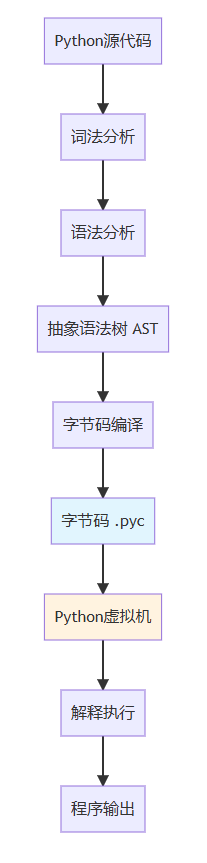
- 理解Python字节码之前,我们需要了解Python虚拟机的执行模型:
- dis模块是Python标准库中的反汇编工具,它可以将字节码转换回人类可读的指令形式。 # dis模块深度探索 import dis import sys from types import CodeType, FunctionType class DisModuleExplorer: “””dis模块功能探索器””” def demonstrate_basic_disassembly(self): “””演示基本反汇编功能””” print(“=== 基本反汇编功能 ===”) # 简单的函数定义 def simple_function(a, b): c = a + b return c * 2 print(“源代码:”) print(” def simple_function(a, b):”) print(” c = a + b”) print(” return c * 2″) print(“n反汇编结果:”) dis.dis(simple_function) def analyze_code_object(self): “””分析代码对象结构””” print(“n=== 代码对象结构分析 ===”) def sample_function(x, y=10): z = x + y for i in range(3): z += i return z # 获取代码对象 code_obj = sample_function.__code__ print(“代码对象属性:”) attributes = [ (‘co_name’, ‘函数名’), (‘co_argcount’, ‘参数数量’), (‘co_nlocals’, ‘局部变量数量’), (‘co_stacksize’, ‘栈大小’), (‘co_flags’, ‘标志位’), (‘co_code’, ‘字节码序列’), (‘co_consts’, ‘常量元组’), (‘co_names’, ‘名称元组’), (‘co_varnames’, ‘变量名元组’), (‘co_filename’, ‘文件名’), (‘co_firstlineno’, ‘第一行号’), (‘co_lnotab’, ‘行号表’), (‘co_freevars’, ‘自由变量’), (‘co_cellvars’, ‘单元格变量’) ] for attr, description in attributes: if hasattr(code_obj, attr): value = getattr(code_obj, attr) print(f” {attr:<15} {description}: {value}”) def demonstrate_advanced_dis_features(self): “””演示高级dis功能””” print(“n=== 高级dis功能 ===”) def complex_function(data): result = [] for item in data: if item % 2 == 0: result.append(item ** 2) else: result.append(item * 3) return sum(result) # 1. 显示字节码指令 print(“1. 标准反汇编:”) dis.dis(complex_function) # 2. 获取指令列表 print(“n2. 指令列表:”) instructions = dis.get_instructions(complex_function) for instr in instructions: print(f” {instr.opname:<20} {instr.arg:>4} {instr.argval}”) # 3. 显示堆栈效果 print(“n3. 堆栈效果分析:”) self._show_stack_effect(complex_function) def _show_stack_effect(self, func): “””显示指令的堆栈效果””” code_obj = func.__code__ bytecode = code_obj.co_code print(f”函数: {func.__name__}, 所需栈大小: {code_obj.co_stacksize}”) # 简化的堆栈效果分析 stack_effect = { ‘LOAD_FAST’: 1, # 推入一个值 ‘LOAD_CONST’: 1, # 推入一个值 ‘STORE_FAST’: -1, # 弹出一个值 ‘BINARY_ADD’: -1, # 弹出两个值,推入一个值 ‘RETURN_VALUE’: -1, # 弹出一个值 } instructions = list(dis.get_instructions(func)) current_stack = 0 max_stack = 0 print(” 指令执行过程中的堆栈变化:”) for instr in instructions: effect = stack_effect.get(instr.opname, 0) current_stack += effect max_stack = max(max_stack, current_stack) print(f” {instr.opname:<20} 堆栈效果: {effect:>+2}, 当前堆栈: {current_stack:>2}”) print(f” 最大堆栈深度: {max_stack}”) # 字节码可视化工具 class BytecodeVisualizer: “””字节码可视化工具””” @staticmethod def show_bytecode_hex(code_obj): “””显示字节码的十六进制表示””” print(“n=== 字节码十六进制表示 ===”) bytecode = code_obj.co_code print(f”字节码长度: {len(bytecode)} 字节”) print(“十六进制:”, bytecode.hex()) # 解析字节码序列 print(“n字节码解析:”) i = 0 while i < len(bytecode): opcode = bytecode[i] opname_str = opname[opcode] if opcode < len(opname) else f”UNKNOWN({opcode})” if opcode >= dis.HAVE_ARGUMENT: arg = bytecode[i+1] + (bytecode[i+2] << 8) print(f” 偏移 {i:3d}: {opname_str:<20} 参数: {arg:5d}”) i += 3 else: print(f” 偏移 {i:3d}: {opname_str:<20}”) i += 1 def demo_dis_module(): “””演示dis模块功能””” explorer = DisModuleExplorer() explorer.demonstrate_basic_disassembly() explorer.analyze_code_object() explorer.demonstrate_advanced_dis_features() # 可视化演示 def sample_func(): return 42 visualizer = BytecodeVisualizer() visualizer.show_bytecode_hex(sample_func.__code__) if __name__ == “__main__”: demo_dis_module()
- 让我们深入理解最常见的字节码指令及其作用: # 字节码指令深度解析 import dis from opcode import opmap, opname class BytecodeInstructionAnalyzer: “””字节码指令深度分析器””” def analyze_common_instructions(self): “””分析常见指令””” print(“=== 常见字节码指令分析 ===”) instructions_analysis = { “LOAD_FAST”: { “功能”: “加载局部变量到栈顶”, “参数”: “局部变量索引”, “栈效果”: “+1”, “示例”: “加载函数参数或局部变量” }, “LOAD_CONST”: { “功能”: “加载常量到栈顶”, “参数”: “常量元组索引”, “栈效果”: “+1”, “示例”: “加载数字、字符串等常量” }, “LOAD_GLOBAL”: { “功能”: “加载全局变量到栈顶”, “参数”: “全局名称索引”, “栈效果”: “+1”, “示例”: “加载全局函数或变量” }, “STORE_FAST”: { “功能”: “存储栈顶值到局部变量”, “参数”: “局部变量索引”, “栈效果”: “-1”, “示例”: “保存计算结果到变量” }, “BINARY_ADD”: { “功能”: “二进制加法运算”, “参数”: “无”, “栈效果”: “-1”, “示例”: “执行 a + b 操作” }, “CALL_FUNCTION”: { “功能”: “调用函数”, “参数”: “参数数量”, “栈效果”: “-(参数数量), +1”, “示例”: “调用函数或方法” }, “RETURN_VALUE”: { “功能”: “从函数返回值”, “参数”: “无”, “栈效果”: “-1”, “示例”: “函数返回语句” } } for instr, info in instructions_analysis.items(): print(f”n{instr}:”) for key, value in info.items(): print(f” {key}: {value}”) def demonstrate_instruction_sequences(self): “””演示指令序列模式””” print(“n=== 常见指令序列模式 ===”) # 模式1: 变量赋值 print(“1. 变量赋值模式:”) def assignment_pattern(): x = 10 y = 20 z = x + y dis.dis(assignment_pattern) # 模式2: 条件判断 print(“n2. 条件判断模式:”) def condition_pattern(a, b): if a > b: return a else: return b dis.dis(condition_pattern) # 模式3: 循环结构 print(“n3. 循环结构模式:”) def loop_pattern(n): total = 0 for i in range(n): total += i return total dis.dis(loop_pattern) def show_opcode_statistics(self): “””显示操作码统计””” print(“n=== 操作码统计 ===”) def complex_example(data): results = [] for item in data: if isinstance(item, (int, float)): squared = item ** 2 results.append(squared) elif isinstance(item, str): results.append(item.upper()) return results # 统计指令使用频率 from collections import Counter instructions = list(dis.get_instructions(complex_example)) opcode_counter = Counter(instr.opname for instr in instructions) print(“指令使用频率:”) for opcode, count in opcode_counter.most_common(): print(f” {opcode:<20}: {count:>2} 次”) # 指令执行模拟器 class InstructionSimulator: “””字节码指令执行模拟器””” def __init__(self): self.stack = [] self.locals = {} self.consts = [] self.names = [] def simulate_instructions(self, instructions): “””模拟指令执行””” print(“n=== 指令执行模拟 ===”) for instr in instructions: print(f”执行: {instr.opname:<20} | 栈: {self.stack}”) if instr.opname == “LOAD_CONST”: self.stack.append(instr.argval) elif instr.opname == “STORE_FAST”: self.locals[instr.argval] = self.stack.pop() elif instr.opname == “LOAD_FAST”: self.stack.append(self.locals[instr.argval]) elif instr.opname == “BINARY_ADD”: b = self.stack.pop() a = self.stack.pop() self.stack.append(a + b) elif instr.opname == “RETURN_VALUE”: result = self.stack.pop() print(f”返回结果: {result}”) return result return None def demo_instruction_analysis(): “””演示指令分析””” analyzer = BytecodeInstructionAnalyzer() analyzer.analyze_common_instructions() analyzer.demonstrate_instruction_sequences() analyzer.show_opcode_statistics() # 指令模拟演示 print(“n” + “=”*50) def simple_calculation(): a = 5 b = 3 c = a + b return c simulator = InstructionSimulator() simulator.consts = simple_calculation.__code__.co_consts simulator.names = simple_calculation.__code__.co_names instructions = list(dis.get_instructions(simple_calculation)) # 过滤掉设置相关的指令,只关注核心计算 core_instructions = [instr for instr in instructions if instr.opname in [‘LOAD_CONST’, ‘STORE_FAST’, ‘LOAD_FAST’, ‘BINARY_ADD’, ‘RETURN_VALUE’]] simulator.simulate_instructions(core_instructions) if __name__ == “__main__”: demo_instruction_analysis()
- 不同代码结构会生成特定的字节码模式,理解这些模式有助于我们深入理解Python执行机制。 # 控制结构字节码分析 import dis from collections import defaultdict class ControlStructureAnalyzer: “””控制结构字节码分析器””” def analyze_conditional_statements(self): “””分析条件语句的字节码””” print(“=== 条件语句字节码分析 ===”) # if-else 结构 def if_else_example(x): if x > 0: return “positive” else: return “non-positive” print(“1. if-else 结构:”) dis.dis(if_else_example) # if-elif-else 结构 def if_elif_else_example(x): if x > 0: return “positive” elif x < 0: return “negative” else: return “zero” print(“n2. if-elif-else 结构:”) dis.dis(if_elif_else_example) # 条件表达式 def conditional_expression(x): return “even” if x % 2 == 0 else “odd” print(“n3. 条件表达式:”) dis.dis(conditional_expression) def analyze_loop_structures(self): “””分析循环结构的字节码””” print(“n=== 循环结构字节码分析 ===”) # for 循环 def for_loop_example(items): total = 0 for item in items: total += item return total print(“1. for 循环:”) dis.dis(for_loop_example) # while 循环 def while_loop_example(n): i = 0 total = 0 while i < n: total += i i += 1 return total print(“n2. while 循环:”) dis.dis(while_loop_example) # 列表推导式 def list_comprehension_example(items): return [x * 2 for x in items if x > 0] print(“n3. 列表推导式:”) dis.dis(list_comprehension_example) def analyze_function_calls(self): “””分析函数调用的字节码””” print(“n=== 函数调用字节码分析 ===”) def helper_function(x): return x * 2 def function_call_example(a, b): result1 = helper_function(a) result2 = helper_function(b) return result1 + result2 print(“函数调用模式:”) dis.dis(function_call_example) # 方法调用 def method_call_example(): text = “hello” return text.upper().lower() print(“n方法调用链:”) dis.dis(method_call_example) def demonstrate_bytecode_patterns(self): “””演示字节码模式识别””” print(“n=== 字节码模式识别 ===”) patterns = { “变量赋值”: [“LOAD_CONST”, “STORE_FAST”], “二元运算”: [“LOAD_FAST”, “LOAD_FAST”, “BINARY_*”, “STORE_FAST”], “函数调用”: [“LOAD_GLOBAL”, “LOAD_FAST”, “CALL_FUNCTION”, “STORE_FAST”], “条件跳转”: [“LOAD_FAST”, “COMPARE_OP”, “POP_JUMP_IF_FALSE”], “循环结构”: [“SETUP_LOOP”, “GET_ITER”, “FOR_ITER”] } print(“常见字节码模式:”) for pattern_name, instruction_sequence in patterns.items(): print(f” {pattern_name}: {‘ → ‘.join(instruction_sequence)}”) # 性能模式分析 class PerformancePatternAnalyzer: “””性能模式分析器””” @staticmethod def compare_efficient_vs_inefficient(): “””比较高效与低效代码的字节码””” print(“n=== 高效 vs 低效代码字节码比较 ===”) # 低效版本 def inefficient_loop(n): result = [] for i in range(n): result.append(i * 2) return result # 高效版本 def efficient_loop(n): return [i * 2 for i in range(n)] print(“1. 低效循环版本:”) dis.dis(inefficient_loop) print(“n2. 高效列表推导式版本:”) dis.dis(efficient_loop) # 分析差异 print(“n主要差异:”) differences = [ “列表推导式避免了方法调用开销”, “减少了局部变量的使用”, “更少的指令数量”, “更好的内存分配模式” ] for diff in differences: print(f” • {diff}”) def demo_control_structures(): “””演示控制结构分析””” analyzer = ControlStructureAnalyzer() analyzer.analyze_conditional_statements() analyzer.analyze_loop_structures() analyzer.analyze_function_calls() analyzer.demonstrate_bytecode_patterns() PerformancePatternAnalyzer.compare_efficient_vs_inefficient() if __name__ == “__main__”: demo_control_structures()
- Python的高级特性如装饰器、生成器、上下文管理器等都有独特的字节码模式。 # 高级语言特性字节码分析 import dis import functools from contextlib import contextmanager class AdvancedFeatureAnalyzer: “””高级语言特性字节码分析器””” def analyze_decorators(self): “””分析装饰器的字节码””” print(“=== 装饰器字节码分析 ===”) def simple_decorator(func): @functools.wraps(func) def wrapper(*args, **kwargs): print(f”调用函数: {func.__name__}”) return func(*args, **kwargs) return wrapper @simple_decorator def decorated_function(x): return x * 2 print(“装饰器函数:”) dis.dis(simple_decorator) print(“n被装饰的函数:”) dis.dis(decorated_function) # 显示装饰器应用过程 print(“n装饰器应用等价代码:”) def equivalent_code(): def original_function(x): return x * 2 # 手动应用装饰器 decorated = simple_decorator(original_function) return decorated dis.dis(equivalent_code) def analyze_generators(self): “””分析生成器的字节码””” print(“n=== 生成器字节码分析 ===”) def simple_generator(n): for i in range(n): yield i * 2 def equivalent_loop(n): result = [] for i in range(n): result.append(i * 2) return result print(“1. 生成器函数:”) dis.dis(simple_generator) print(“n2. 等效循环函数:”) dis.dis(equivalent_loop) # 分析生成器特性 gen_code = simple_generator.__code__ print(f”n生成器特性:”) print(f” 协程标志: {gen_code.co_flags & 0x100 != 0}”) print(f” 生成器标志: {gen_code.co_flags & 0x20 != 0}”) print(f” 包含 YIELD_VALUE 指令: {‘YIELD_VALUE’ in [instr.opname for instr in dis.get_instructions(simple_generator)]}”) def analyze_context_managers(self): “””分析上下文管理器的字节码””” print(“n=== 上下文管理器字节码分析 ===”) @contextmanager def simple_context(): print(“进入上下文”) try: yield “resource” finally: print(“退出上下文”) def use_context_manager(): with simple_context() as resource: print(f”使用资源: {resource}”) return resource.upper() print(“上下文管理器使用:”) dis.dis(use_context_manager) # 显示等效的try-finally结构 print(“n等效的try-finally结构:”) def equivalent_try_finally(): manager = simple_context() resource = manager.__enter__() try: print(f”使用资源: {resource}”) result = resource.upper() finally: manager.__exit__(None, None, None) return result dis.dis(equivalent_try_finally) def analyze_class_definitions(self): “””分析类定义的字节码””” print(“n=== 类定义字节码分析 ===”) class SimpleClass: class_attribute = “class_value” def __init__(self, value): self.instance_attribute = value def method(self): return self.instance_attribute * 2 print(“类定义字节码:”) dis.dis(SimpleClass) # 分析方法调用 print(“n实例方法调用:”) def method_call_demo(): obj = SimpleClass(“test”) return obj.method() dis.dis(method_call_demo) # 字节码优化分析 class BytecodeOptimizationAnalyzer: “””字节码优化分析器””” @staticmethod def demonstrate_constant_folding(): “””演示常量折叠优化””” print(“n=== 常量折叠优化 ===”) # 常量表达式会在编译时计算 def with_constant_folding(): return 10 + 20 * 3 # 编译时计算为70 def without_constant_folding(a, b, c): return a + b * c # 运行时计算 print(“1. 常量折叠优化:”) dis.dis(with_constant_folding) print(“n2. 无常量折叠:”) dis.dis(without_constant_folding) print(f”n常量折叠结果: {with_constant_folding()}”) @staticmethod def demonstrate_peephole_optimizations(): “””演示窥孔优化””” print(“n=== 窥孔优化 ===”) # 元组代替列表 def tuple_vs_list(): # 这些会在编译时优化 a = [1, 2, 3] # 可能被优化为元组 b = (1, 2, 3) return a, b print(“元组/列表优化:”) dis.dis(tuple_vs_list) # 字符串连接优化 def string_optimization(): # 字符串连接优化 return “hello” + ” ” + “world” # 编译时连接 print(“n字符串连接优化:”) dis.dis(string_optimization) def demo_advanced_features(): “””演示高级特性分析””” analyzer = AdvancedFeatureAnalyzer() analyzer.analyze_decorators() analyzer.analyze_generators() analyzer.analyze_context_managers() analyzer.analyze_class_definitions() BytecodeOptimizationAnalyzer.demonstrate_constant_folding() BytecodeOptimizationAnalyzer.demonstrate_peephole_optimizations() if __name__ == “__main__”: demo_advanced_features()
- 字节码基础:Python代码编译后的中间表示,由Python虚拟机执行 dis模块:强大的反汇编工具,可将字节码转换回可读的指令形式 指令系统:基于栈的操作模型,包含加载、存储、运算、控制流等指令类型 性能分析:通过字节码模式识别性能瓶颈和优化机会
- 控制结构模式:if-else、循环、函数调用等都有特定的字节码模式 高级特性实现:装饰器、生成器、上下文管理器等的字节码表现 优化技巧:常量折叠、窥孔优化、指令选择等编译器优化 动态操作:代码对象创建、字节码修补等高级技巧
- 掌握字节码分析具有重要的实践意义: 性能优化:识别性能瓶颈,实施针对性优化 代码理解:深入理解Python语言特性和执行机制 调试能力:定位复杂问题的根本原因 元编程:实现动态代码生成和修改
目录
- 引言
- 一、Python字节码基础
- 1.1 什么是字节码
- 1.2 Python执行模型
- 二、dis模块深度探索
- 2.1 dis模块核心功能
- 2.2 字节码指令详解
- 三、代码结构字节码分析
- 3.1 控制结构字节码
- 3.2 高级语言特性字节码
- 四、字节码性能分析
- 五、高级字节码技巧
- 六、完整字节码分析工具
- 七、代码质量自查与最佳实践
- 总结
- 核心知识回顾
- 关键技术要点
- 实践应用价值
- 工具与方法 论
Python作为一门解释型语言,其代码执行过程对于大多数开发者来说似乎是一个"黑盒"。我们编写.py文件,Python解释器执行它,但中间发生了什么?答案就藏在Python字节码中。字节码是Python源代码编译后的中间表示,是Python虚拟机(PVM)实际执行的指令集。通过dis模块,我们可以揭开这层神秘面纱,深入理解Python代码的执行机制。本文将带领您全面探索Python字节码的世界,从基础概念到高级技巧,帮助您真正理解Python代码的执行本质。
字节码是Python源代码编译后的中间表示形式,它是平台无关的、基于栈的指令集。当我们执行Python代码时,解释器首先将源代码编译为字节码,然后Python虚拟机执行这些字节码指令。
# 字节码基础概念演示
import dis
import types
from opcode import opname, opmap

class BytecodeFundamentals:
    """字节码基础概念演示类"""

    def explain_bytecode_concept(self):
        """解释字节码的基本概念"""
        concepts = {
            "字节码定义": "Python源代码编译后的中间表示形式",
            "文件扩展名": ".pyc (编译后的Python文件)",
            "执行环境": "Python虚拟机(PVM)",
            "指令特点": "基于栈的操作、平台无关、比源代码更接近机器码",
            "查看工具": "dis模块(反汇编器)"
        }

        print("Python字节码核心概念:")
        for concept, description in concepts.items():
            print(f"  • {concept}: {description}")

        return concepts

    def demonstrate_compilation_process(self):
        """演示编译过程"""
        print("n=== Python代码编译过程 ===")

        # 源代码
        source_code = """
def calculate(x, y):
    result = x + y * 2
    return result
"""
        print("1. 源代码:")
        print(source_code)

        # 编译为字节码
        code_obj = compile(source_code, '<string>', 'exec')
        print("2. 编译为代码对象")

        # 提取函数的代码对象
        for const in code_obj.co_consts:
            if isinstance(const, types.CodeType):
                func_code = const
                break

        print("3. 代码对象信息:")
        print(f"   函数名: {func_code.co_name}")
        print(f"   参数数量: {func_code.co_argcount}")
        print(f"   局部变量: {func_code.co_varnames}")
        print(f"   常量: {func_code.co_consts}")

        print("4. 字节码指令:")
        dis.dis(func_code)

# 字节码指令集概述
class BytecodeInstructionSet:
    """字节码指令集分析"""

    @staticmethod
    def show_instruction_categories():
        """显示指令分类"""
        print("n=== 字节码指令分类 ===")

        categories = {
            "栈操作指令": [
                "LOAD_FAST", "LOAD_CONST", "LOAD_GLOBAL",
                "STORE_FAST", "POP_TOP", "DUP_TOP"
            ],
            "算术运算指令": [
                "BINARY_ADD", "BINARY_SUBTRACT", "BINARY_MULTIPLY",
                "BINARY_TRUE_DIVIDE", "INPLACE_ADD"
            ],
            "比较运算指令": [
                "COMPARE_OP", "IS_OP", "CONTAINS_OP"
            ],
            "控制流指令": [
                "JUMP_FORWARD", "JUMP_ABSOLUTE",
                "POP_JUMP_IF_FALSE", "POP_JUMP_IF_TRUE"
            ],
            "函数调用指令": [
                "CALL_FUNCTION", "CALL_METHOD",
                "RETURN_VALUE", "YIELD_VALUE"
            ],
            "容器操作指令": [
                "BUILD_LIST", "BUILD_TUPLE",
                "BUILD_MAP", "BUILD_SET"
            ]
        }

        for category, instructions in categories.items():
            print(f"n{category}:")
            for instr in instructions:
                if instr in opmap:
                    opcode = opmap[instr]
                    print(f"  {instr:<20} (操作码: {opcode:3d})")

def demo_fundamentals():
    """演示字节码基础"""
    fundamentals = BytecodeFundamentals()
    fundamentals.explain_bytecode_concept()
    fundamentals.demonstrate_compilation_process()

    BytecodeInstructionSet.show_instruction_categories()

if __name__ == "__main__":
    demo_fundamentals()
理解Python字节码之前,我们需要了解Python虚拟机的执行模型:
dis模块是Python标准库中的反汇编工具,它可以将字节码转换回人类可读的指令形式。
# dis模块深度探索
import dis
import sys
from types import CodeType, FunctionType

class DisModuleExplorer:
    """dis模块功能探索器"""

    def demonstrate_basic_disassembly(self):
        """演示基本反汇编功能"""
        print("=== 基本反汇编功能 ===")

        # 简单的函数定义
        def simple_function(a, b):
            c = a + b
            return c * 2

        print("源代码:")
        print("  def simple_function(a, b):")
        print("      c = a + b")
        print("      return c * 2")

        print("n反汇编结果:")
        dis.dis(simple_function)

    def analyze_code_object(self):
        """分析代码对象结构"""
        print("n=== 代码对象结构分析 ===")

        def sample_function(x, y=10):
            z = x + y
            for i in range(3):
                z += i
            return z

        # 获取代码对象
        code_obj = sample_function.__code__

        print("代码对象属性:")
        attributes = [
            ('co_name', '函数名'),
            ('co_argcount', '参数数量'),
            ('co_nlocals', '局部变量数量'),
            ('co_stacksize', '栈大小'),
            ('co_flags', '标志位'),
            ('co_code', '字节码序列'),
            ('co_consts', '常量元组'),
            ('co_names', '名称元组'),
            ('co_varnames', '变量名元组'),
            ('co_filename', '文件名'),
            ('co_firstlineno', '第一行号'),
            ('co_lnotab', '行号表'),
            ('co_freevars', '自由变量'),
            ('co_cellvars', '单元格变量')
        ]

        for attr, description in attributes:
            if hasattr(code_obj, attr):
                value = getattr(code_obj, attr)
                print(f"  {attr:<15} {description}: {value}")

    def demonstrate_advanced_dis_features(self):
        """演示高级dis功能"""
        print("n=== 高级dis功能 ===")

        def complex_function(data):
            result = []
            for item in data:
                if item % 2 == 0:
                    result.append(item ** 2)
                else:
                    result.append(item * 3)
            return sum(result)

        # 1. 显示字节码指令
        print("1. 标准反汇编:")
        dis.dis(complex_function)

        # 2. 获取指令列表
        print("n2. 指令列表:")
        instructions = dis.get_instructions(complex_function)
        for instr in instructions:
            print(f"   {instr.opname:<20} {instr.arg:>4} {instr.argval}")

        # 3. 显示堆栈效果
        print("n3. 堆栈效果分析:")
        self._show_stack_effect(complex_function)

    def _show_stack_effect(self, func):
        """显示指令的堆栈效果"""
        code_obj = func.__code__
        bytecode = code_obj.co_code

        print(f"函数: {func.__name__}, 所需栈大小: {code_obj.co_stacksize}")

        # 简化的堆栈效果分析
        stack_effect = {
            'LOAD_FAST': 1,      # 推入一个值
            'LOAD_CONST': 1,     # 推入一个值
            'STORE_FAST': -1,    # 弹出一个值
            'BINARY_ADD': -1,    # 弹出两个值,推入一个值
            'RETURN_VALUE': -1,  # 弹出一个值
        }

        instructions = list(dis.get_instructions(func))
        current_stack = 0
        max_stack = 0

        print("  指令执行过程中的堆栈变化:")
        for instr in instructions:
            effect = stack_effect.get(instr.opname, 0)
            current_stack += effect
            max_stack = max(max_stack, current_stack)

            print(f"    {instr.opname:<20} 堆栈效果: {effect:>+2}, 当前堆栈: {current_stack:>2}")

        print(f"  最大堆栈深度: {max_stack}")

# 字节码可视化工具
class BytecodeVisualizer:
    """字节码可视化工具"""

    @staticmethod
    def show_bytecode_hex(code_obj):
        """显示字节码的十六进制表示"""
        print("n=== 字节码十六进制表示 ===")

        bytecode = code_obj.co_code
        print(f"字节码长度: {len(bytecode)} 字节")
        print("十六进制:", bytecode.hex())

        # 解析字节码序列
        print("n字节码解析:")
        i = 0
        while i < len(bytecode):
            opcode = bytecode[i]
            opname_str = opname[opcode] if opcode < len(opname) else f"UNKNOWN({opcode})"

            if opcode >= dis.HAVE_ARGUMENT:
                arg = bytecode[i+1] + (bytecode[i+2] << 8)
                print(f"  偏移 {i:3d}: {opname_str:<20} 参数: {arg:5d}")
                i += 3
            else:
                print(f"  偏移 {i:3d}: {opname_str:<20}")
                i += 1

def demo_dis_module():
    """演示dis模块功能"""
    explorer = DisModuleExplorer()
    explorer.demonstrate_basic_disassembly()
    explorer.analyze_code_object()
    explorer.demonstrate_advanced_dis_features()

    # 可视化演示
    def sample_func():
        return 42

    visualizer = BytecodeVisualizer()
    visualizer.show_bytecode_hex(sample_func.__code__)

if __name__ == "__main__":
    demo_dis_module()
让我们深入理解最常见的字节码指令及其作用:
# 字节码指令深度解析
import dis
from opcode import opmap, opname

class BytecodeInstructionAnalyzer:
    """字节码指令深度分析器"""

    def analyze_common_instructions(self):
        """分析常见指令"""
        print("=== 常见字节码指令分析 ===")

        instructions_analysis = {
            "LOAD_FAST": {
                "功能": "加载局部变量到栈顶",
                "参数": "局部变量索引",
                "栈效果": "+1",
                "示例": "加载函数参数或局部变量"
            },
            "LOAD_CONST": {
                "功能": "加载常量到栈顶",
                "参数": "常量元组索引",
                "栈效果": "+1",
                "示例": "加载数字、字符串等常量"
            },
            "LOAD_GLOBAL": {
                "功能": "加载全局变量到栈顶",
                "参数": "全局名称索引",
                "栈效果": "+1",
                "示例": "加载全局函数或变量"
            },
            "STORE_FAST": {
                "功能": "存储栈顶值到局部变量",
                "参数": "局部变量索引",
                "栈效果": "-1",
                "示例": "保存计算结果到变量"
            },
            "BINARY_ADD": {
                "功能": "二进制加法运算",
                "参数": "无",
                "栈效果": "-1",
                "示例": "执行 a + b 操作"
            },
            "CALL_FUNCTION": {
                "功能": "调用函数",
                "参数": "参数数量",
                "栈效果": "-(参数数量), +1",
                "示例": "调用函数或方法"
            },
            "RETURN_VALUE": {
                "功能": "从函数返回值",
                "参数": "无",
                "栈效果": "-1",
                "示例": "函数返回语句"
            }
        }

        for instr, info in instructions_analysis.items():
            print(f"n{instr}:")
            for key, value in info.items():
                print(f"  {key}: {value}")

    def demonstrate_instruction_sequences(self):
        """演示指令序列模式"""
        print("n=== 常见指令序列模式 ===")

        # 模式1: 变量赋值
        print("1. 变量赋值模式:")
        def assignment_pattern():
            x = 10
            y = 20
            z = x + y

        dis.dis(assignment_pattern)

        # 模式2: 条件判断
        print("n2. 条件判断模式:")
        def condition_pattern(a, b):
            if a > b:
                return a
            else:
                return b

        dis.dis(condition_pattern)

        # 模式3: 循环结构
        print("n3. 循环结构模式:")
        def loop_pattern(n):
            total = 0
            for i in range(n):
                total += i
            return total

        dis.dis(loop_pattern)

    def show_opcode_statistics(self):
        """显示操作码统计"""
        print("n=== 操作码统计 ===")

        def complex_example(data):
            results = []
            for item in data:
                if isinstance(item, (int, float)):
                    squared = item ** 2
                    results.append(squared)
                elif isinstance(item, str):
                    results.append(item.upper())
            return results

        # 统计指令使用频率
        from collections import Counter

        instructions = list(dis.get_instructions(complex_example))
        opcode_counter = Counter(instr.opname for instr in instructions)

        print("指令使用频率:")
        for opcode, count in opcode_counter.most_common():
            print(f"  {opcode:<20}: {count:>2} 次")

# 指令执行模拟器
class InstructionSimulator:
    """字节码指令执行模拟器"""

    def __init__(self):
        self.stack = []
        self.locals = {}
        self.consts = []
        self.names = []

    def simulate_instructions(self, instructions):
        """模拟指令执行"""
        print("n=== 指令执行模拟 ===")

        for instr in instructions:
            print(f"执行: {instr.opname:<20} | 栈: {self.stack}")

            if instr.opname == "LOAD_CONST":
                self.stack.append(instr.argval)
            elif instr.opname == "STORE_FAST":
                self.locals[instr.argval] = self.stack.pop()
            elif instr.opname == "LOAD_FAST":
                self.stack.append(self.locals[instr.argval])
            elif instr.opname == "BINARY_ADD":
                b = self.stack.pop()
                a = self.stack.pop()
                self.stack.append(a + b)
            elif instr.opname == "RETURN_VALUE":
                result = self.stack.pop()
                print(f"返回结果: {result}")
                return result

        return None

def demo_instruction_analysis():
    """演示指令分析"""
    analyzer = BytecodeInstructionAnalyzer()
    analyzer.analyze_common_instructions()
    analyzer.demonstrate_instruction_sequences()
    analyzer.show_opcode_statistics()

    # 指令模拟演示
    print("n" + "="*50)

    def simple_calculation():
        a = 5
        b = 3
        c = a + b
        return c

    simulator = InstructionSimulator()
    simulator.consts = simple_calculation.__code__.co_consts
    simulator.names = simple_calculation.__code__.co_names

    instructions = list(dis.get_instructions(simple_calculation))
    # 过滤掉设置相关的指令,只关注核心计算
    core_instructions = [instr for instr in instructions
                        if instr.opname in ['LOAD_CONST', 'STORE_FAST', 'LOAD_FAST', 'BINARY_ADD', 'RETURN_VALUE']]

    simulator.simulate_instructions(core_instructions)

if __name__ == "__main__":
    demo_instruction_analysis()
不同代码结构会生成特定的字节码模式,理解这些模式有助于我们深入理解Python执行机制。
# 控制结构字节码分析
import dis
from collections import defaultdict

class ControlStructureAnalyzer:
    """控制结构字节码分析器"""

    def analyze_conditional_statements(self):
        """分析条件语句的字节码"""
        print("=== 条件语句字节码分析 ===")

        # if-else 结构
        def if_else_example(x):
            if x > 0:
                return "positive"
            else:
                return "non-positive"

        print("1. if-else 结构:")
        dis.dis(if_else_example)

        # if-elif-else 结构
        def if_elif_else_example(x):
            if x > 0:
                return "positive"
            elif x < 0:
                return "negative"
            else:
                return "zero"

        print("n2. if-elif-else 结构:")
        dis.dis(if_elif_else_example)

        # 条件表达式
        def conditional_expression(x):
            return "even" if x % 2 == 0 else "odd"

        print("n3. 条件表达式:")
        dis.dis(conditional_expression)

    def analyze_loop_structures(self):
        """分析循环结构的字节码"""
        print("n=== 循环结构字节码分析 ===")

        # for 循环
        def for_loop_example(items):
            total = 0
            for item in items:
                total += item
            return total

        print("1. for 循环:")
        dis.dis(for_loop_example)

        # while 循环
        def while_loop_example(n):
            i = 0
            total = 0
            while i < n:
                total += i
                i += 1
            return total

        print("n2. while 循环:")
        dis.dis(while_loop_example)

        # 列表推导式
        def list_comprehension_example(items):
            return [x * 2 for x in items if x > 0]

        print("n3. 列表推导式:")
        dis.dis(list_comprehension_example)

    def analyze_function_calls(self):
        """分析函数调用的字节码"""
        print("n=== 函数调用字节码分析 ===")

        def helper_function(x):
            return x * 2

        def function_call_example(a, b):
            result1 = helper_function(a)
            result2 = helper_function(b)
            return result1 + result2

        print("函数调用模式:")
        dis.dis(function_call_example)

        # 方法调用
        def method_call_example():
            text = "hello"
            return text.upper().lower()

        print("n方法调用链:")
        dis.dis(method_call_example)

    def demonstrate_bytecode_patterns(self):
        """演示字节码模式识别"""
        print("n=== 字节码模式识别 ===")

        patterns = {
            "变量赋值": ["LOAD_CONST", "STORE_FAST"],
            "二元运算": ["LOAD_FAST", "LOAD_FAST", "BINARY_*", "STORE_FAST"],
            "函数调用": ["LOAD_GLOBAL", "LOAD_FAST", "CALL_FUNCTION", "STORE_FAST"],
            "条件跳转": ["LOAD_FAST", "COMPARE_OP", "POP_JUMP_IF_FALSE"],
            "循环结构": ["SETUP_LOOP", "GET_ITER", "FOR_ITER"]
        }

        print("常见字节码模式:")
        for pattern_name, instruction_sequence in patterns.items():
            print(f"  {pattern_name}: {' → '.join(instruction_sequence)}")

# 性能模式分析
class PerformancePatternAnalyzer:
    """性能模式分析器"""

    @staticmethod
    def compare_efficient_vs_inefficient():
        """比较高效与低效代码的字节码"""
        print("n=== 高效 vs 低效代码字节码比较 ===")

        # 低效版本
        def inefficient_loop(n):
            result = []
            for i in range(n):
                result.append(i * 2)
            return result

        # 高效版本
        def efficient_loop(n):
            return [i * 2 for i in range(n)]

        print("1. 低效循环版本:")
        dis.dis(inefficient_loop)

        print("n2. 高效列表推导式版本:")
        dis.dis(efficient_loop)

        # 分析差异
        print("n主要差异:")
        differences = [
            "列表推导式避免了方法调用开销",
            "减少了局部变量的使用",
            "更少的指令数量",
            "更好的内存分配模式"
        ]

        for diff in differences:
            print(f"  • {diff}")

def demo_control_structures():
    """演示控制结构分析"""
    analyzer = ControlStructureAnalyzer()
    analyzer.analyze_conditional_statements()
    analyzer.analyze_loop_structures()
    analyzer.analyze_function_calls()
    analyzer.demonstrate_bytecode_patterns()

    PerformancePatternAnalyzer.compare_efficient_vs_inefficient()

if __name__ == "__main__":
    demo_control_structures()
Python的高级特性如装饰器、生成器、上下文管理器等都有独特的字节码模式。
# 高级语言特性字节码分析
import dis
import functools
from contextlib import contextmanager

class AdvancedFeatureAnalyzer:
    """高级语言特性字节码分析器"""

    def analyze_decorators(self):
        """分析装饰器的字节码"""
        print("=== 装饰器字节码分析 ===")

        def simple_decorator(func):
            @functools.wraps(func)
            def wrapper(*args, **kwargs):
                print(f"调用函数: {func.__name__}")
                return func(*args, **kwargs)
            return wrapper

        @simple_decorator
        def decorated_function(x):
            return x * 2

        print("装饰器函数:")
        dis.dis(simple_decorator)

        print("n被装饰的函数:")
        dis.dis(decorated_function)

        # 显示装饰器应用过程
        print("n装饰器应用等价代码:")
        def equivalent_code():
            def original_function(x):
                return x * 2

            # 手动应用装饰器
            decorated = simple_decorator(original_function)
            return decorated

        dis.dis(equivalent_code)

    def analyze_generators(self):
        """分析生成器的字节码"""
        print("n=== 生成器字节码分析 ===")

        def simple_generator(n):
            for i in range(n):
                yield i * 2

        def equivalent_loop(n):
            result = []
            for i in range(n):
                result.append(i * 2)
            return result

        print("1. 生成器函数:")
        dis.dis(simple_generator)

        print("n2. 等效循环函数:")
        dis.dis(equivalent_loop)

        # 分析生成器特性
        gen_code = simple_generator.__code__
        print(f"n生成器特性:")
        print(f"  协程标志: {gen_code.co_flags & 0x100 != 0}")
        print(f"  生成器标志: {gen_code.co_flags & 0x20 != 0}")
        print(f"  包含 YIELD_VALUE 指令: {'YIELD_VALUE' in [instr.opname for instr in dis.get_instructions(simple_generator)]}")

    def analyze_context_managers(self):
        """分析上下文管理器的字节码"""
        print("n=== 上下文管理器字节码分析 ===")

        @contextmanager
        def simple_context():
            print("进入上下文")
            try:
                yield "resource"
            finally:
                print("退出上下文")

        def use_context_manager():
            with simple_context() as resource:
                print(f"使用资源: {resource}")
                return resource.upper()

        print("上下文管理器使用:")
        dis.dis(use_context_manager)

        # 显示等效的try-finally结构
        print("n等效的try-finally结构:")
        def equivalent_try_finally():
            manager = simple_context()
            resource = manager.__enter__()
            try:
                print(f"使用资源: {resource}")
                result = resource.upper()
            finally:
                manager.__exit__(None, None, None)
            return result

        dis.dis(equivalent_try_finally)

    def analyze_class_definitions(self):
        """分析类定义的字节码"""
        print("n=== 类定义字节码分析 ===")

        class SimpleClass:
            class_attribute = "class_value"

            def __init__(self, value):
                self.instance_attribute = value

            def method(self):
                return self.instance_attribute * 2

        print("类定义字节码:")
        dis.dis(SimpleClass)

        # 分析方法调用
        print("n实例方法调用:")
        def method_call_demo():
            obj = SimpleClass("test")
            return obj.method()

        dis.dis(method_call_demo)

# 字节码优化分析
class BytecodeOptimizationAnalyzer:
    """字节码优化分析器"""

    @staticmethod
    def demonstrate_constant_folding():
        """演示常量折叠优化"""
        print("n=== 常量折叠优化 ===")

        # 常量表达式会在编译时计算
        def with_constant_folding():
            return 10 + 20 * 3  # 编译时计算为70

        def without_constant_folding(a, b, c):
            return a + b * c  # 运行时计算

        print("1. 常量折叠优化:")
        dis.dis(with_constant_folding)

        print("n2. 无常量折叠:")
        dis.dis(without_constant_folding)

        print(f"n常量折叠结果: {with_constant_folding()}")

    @staticmethod
    def demonstrate_peephole_optimizations():
        """演示窥孔优化"""
        print("n=== 窥孔优化 ===")

        # 元组代替列表
        def tuple_vs_list():
            # 这些会在编译时优化
            a = [1, 2, 3]  # 可能被优化为元组
            b = (1, 2, 3)
            return a, b

        print("元组/列表优化:")
        dis.dis(tuple_vs_list)

        # 字符串连接优化
        def string_optimization():
            # 字符串连接优化
            return "hello" + " " + "world"  # 编译时连接

        print("n字符串连接优化:")
        dis.dis(string_optimization)

def demo_advanced_features():
    """演示高级特性分析"""
    analyzer = AdvancedFeatureAnalyzer()
    analyzer.analyze_decorators()
    analyzer.analyze_generators()
    analyzer.analyze_context_managers()
    analyzer.analyze_class_definitions()

    BytecodeOptimizationAnalyzer.demonstrate_constant_folding()
    BytecodeOptimizationAnalyzer.demonstrate_peephole_optimizations()

if __name__ == "__main__":
    demo_advanced_features()
性能优化技巧
通过分析字节码,我们可以发现性能瓶颈并实施优化。
# 字节码性能分析与优化
import dis
import timeit
from collections import Counter

class BytecodePerformanceAnalyzer:
    """字节码性能分析器"""

    def __init__(self):
        self.performance_data = {}

    def analyze_instruction_costs(self):
        """分析指令执行成本"""
        print("=== 指令执行成本分析 ===")

        # 基于经验的指令相对成本
        instruction_costs = {
            "LOAD_FAST": 1.0,      # 快速局部变量访问
            "LOAD_CONST": 1.0,     # 快速常量访问
            "LOAD_GLOBAL": 3.0,    # 较慢的全局变量访问
            "STORE_FAST": 1.0,     # 快速局部变量存储
            "BINARY_ADD": 2.0,     # 算术运算
            "CALL_FUNCTION": 10.0, # 函数调用开销
            "IMPORT_NAME": 50.0,   # 导入操作很昂贵
            "BUILD_LIST": 5.0,     # 容器构建
            "FOR_ITER": 3.0,       # 迭代开销
        }

        print("指令相对执行成本:")
        for instr, cost in sorted(instruction_costs.items(), key=lambda x: x[1], reverse=True):
            print(f"  {instr:<20}: {cost:>5.1f}")

    def compare_performance_patterns(self):
        """比较性能模式"""
        print("n=== 性能模式比较 ===")

        # 模式1: 局部变量 vs 全局变量
        global_var = 100

        def use_global():
            return global_var * 2  # 使用全局变量

        def use_local():
            local_var = 100
            return local_var * 2   # 使用局部变量

        print("1. 全局变量 vs 局部变量:")
        print("   全局变量版本:")
        dis.dis(use_global)
        print("   局部变量版本:")
        dis.dis(use_local)

        # 性能测试
        global_time = timeit.timeit(use_global, number=100000)
        local_time = timeit.timeit(use_local, number=100000)

        print(f"   性能比较: 全局={global_time:.4f}s, 局部={local_time:.4f}s")
        print(f"   局部变量快 {global_time/local_time:.1f}x")

        # 模式2: 函数调用开销
        def small_function(x):
            return x + 1

        def with_function_calls(n):
            total = 0
            for i in range(n):
                total += small_function(i)  # 频繁函数调用
            return total

        def without_function_calls(n):
            total = 0
            for i in range(n):
                total += i + 1  # 内联操作
            return total

        print("n2. 函数调用开销:")
        n = 1000
        with_calls_time = timeit.timeit(lambda: with_function_calls(n), number=1000)
        without_calls_time = timeit.timeit(lambda: without_function_calls(n), number=1000)

        print(f"   性能比较: 有调用={with_calls_time:.4f}s, 无调用={without_calls_time:.4f}s")
        print(f"   内联操作快 {with_calls_time/without_calls_time:.1f}x")

    def profile_function_bytecode(self, func, *args):
        """分析函数的字节码性能特征"""
        print(f"n=== 函数字节码性能分析: {func.__name__} ===")

        # 分析指令分布
        instructions = list(dis.get_instructions(func))
        opcode_distribution = Counter(instr.opname for instr in instructions)

        print("指令分布:")
        total_instructions = len(instructions)
        for opcode, count in opcode_distribution.most_common():
            percentage = count / total_instructions * 100
            print(f"  {opcode:<20}: {count:>3} ({percentage:5.1f}%)")

        # 识别性能敏感指令
        expensive_ops = ['CALL_FUNCTION', 'CALL_METHOD', 'LOAD_GLOBAL', 'IMPORT_NAME', 'BUILD_LIST']
        expensive_count = sum(opcode_distribution.get(op, 0) for op in expensive_ops)

        print(f"n性能分析:")
        print(f"  总指令数: {total_instructions}")
        print(f"  昂贵指令数: {expensive_count}")
        print(f"  昂贵指令比例: {expensive_count/total_instructions*100:.1f}%")

        if expensive_count / total_instructions > 0.3:
            print("  ⚠️  警告: 高比例昂贵指令,可能存在性能问题")
        else:
            print("  ✅ 指令分布良好")

        return opcode_distribution

# 实时性能监控
class RuntimePerformanceMonitor:
    """运行时性能监控器"""

    @staticmethod
    def monitor_bytecode_execution(func, *args, **kwargs):
        """监控字节码执行性能"""
        import cProfile
        import pstats
        import io

        print(f"n=== 运行时性能监控: {func.__name__} ===")

        # 使用cProfile进行分析
        pr = cProfile.Profile()
        pr.enable()

        result = func(*args, **kwargs)

        pr.disable()
        s = io.StringIO()
        ps = pstats.Stats(pr, stream=s).sort_stats('cumulative')
        ps.print_stats(10)  # 显示前10个最耗时的函数

        print(s.getvalue())
        return result

    @staticmethod
    def analyze_memory_usage_pattern():
        """分析内存使用模式"""
        print("n=== 内存使用模式分析 ===")

        def memory_intensive():
            # 创建大量临时对象
            result = []
            for i in range(1000):
                # 每次迭代创建新列表
                temp_list = [j for j in range(i % 100)]
                result.append(temp_list)
            return result

        def memory_efficient():
            # 更高效的内存使用
            result = []
            for i in range(1000):
                # 重用模式或使用生成器
                result.append(i % 100)
            return result

        print("内存密集型模式:")
        dis.dis(memory_intensive)

        print("n内存高效模式:")
        dis.dis(memory_efficient)

def demo_performance_analysis():
    """演示性能分析"""
    analyzer = BytecodePerformanceAnalyzer()
    analyzer.analyze_instruction_costs()
    analyzer.compare_performance_patterns()

    # 分析具体函数
    def sample_function(data):
        results = []
        for item in data:
            if item > 0:
                results.append(item ** 2)
        return sum(results)

    analyzer.profile_function_bytecode(sample_function)

    # 运行时监控
    RuntimePerformanceMonitor.analyze_memory_usage_pattern()

if __name__ == "__main__":
    demo_performance_analysis()
动态代码生成与修改
字节码不仅可用于分析,还可以用于动态生成和修改代码。
# 高级字节码技巧:动态代码操作
import dis
import types
import inspect
from opcode import opmap, opname

class DynamicBytecodeManipulator:
    """动态字节码操作器"""

    def demonstrate_code_object_creation(self):
        """演示代码对象创建"""
        print("=== 动态创建代码对象 ===")

        # 手动创建简单的代码对象
        try:
            # 字节码序列 (简化版本)
            # LOAD_CONST 0 (42)
            # RETURN_VALUE
            bytecode = bytes([
                opmap['LOAD_CONST'], 0, 0,  # 加载常量0
                opmap['RETURN_VALUE']       # 返回值
            ])

            # 创建代码对象
            code_obj = types.CodeType(
                0,                          # 参数数量
                0,                          # 位置参数数量
                0,                          # 关键字参数数量
                1,                          # 局部变量数量
                64,                         # 栈大小
                67,                         # 标志位
                bytecode,                   # 字节码
                (42,),                      # 常量 (42)
                (),                         # 名称
                (),                         # 变量名
                '<dynamic>',                # 文件名
                'dynamic_func',             # 函数名
                1,                          # 第一行号
                b''                         # 行号表
            )

            # 创建函数对象
            dynamic_func = types.FunctionType(code_obj, {})

            print("动态创建的函数:")
            result = dynamic_func()
            print(f"执行结果: {result}")

            print("n字节码:")
            dis.dis(dynamic_func)

        except Exception as e:
            print(f"动态创建失败: {e}")

    def demonstrate_bytecode_patching(self):
        """演示字节码修补"""
        print("n=== 字节码修补 ===")

        def original_function(x):
            return x * 2

        print("原始函数:")
        dis.dis(original_function)
        print(f"原始执行: original_function(5) = {original_function(5)}")

        # 修补字节码:将乘法改为加法
        try:
            original_code = original_function.__code__
            original_bytecode = bytearray(original_code.co_code)

            # 查找 BINARY_MULTIPLY 指令并替换为 BINARY_ADD
            for i in range(0, len(original_bytecode), 2):
                if original_bytecode[i] == opmap['BINARY_MULTIPLY']:
                    original_bytecode[i] = opmap['BINARY_ADD']
                    break

            # 创建新的代码对象
            patched_code = types.CodeType(
                original_code.co_argcount,
                original_code.co_posonlyargcount,
                original_code.co_kwonlyargcount,
                original_code.co_nlocals,
                original_code.co_stacksize,
                original_code.co_flags,
                bytes(original_bytecode),
                original_code.co_consts,
                original_code.co_names,
                original_code.co_varnames,
                original_code.co_filename,
                original_code.co_name + "_patched",
                original_code.co_firstlineno,
                original_code.co_lnotab
            )

            # 创建修补后的函数
            patched_function = types.FunctionType(
                patched_code,
                original_function.__globals__,
                original_function.__name__ + "_patched"
            )

            print("n修补后的函数:")
            dis.dis(patched_function)
            print(f"修补后执行: patched_function(5) = {patched_function(5)}")

        except Exception as e:
            print(f"字节码修补失败: {e}")

    def create_optimized_function(self, original_func):
        """创建优化版本的函数"""
        print(f"n=== 为 {original_func.__name__} 创建优化版本 ===")

        # 分析原始函数
        original_instructions = list(dis.get_instructions(original_func))

        print("原始函数分析:")
        expensive_ops = ['LOAD_GLOBAL', 'CALL_FUNCTION']
        expensive_count = sum(1 for instr in original_instructions if instr.opname in expensive_ops)
        print(f"  昂贵操作数量: {expensive_count}")

        # 这里可以实施具体的优化策略
        # 例如:缓存全局变量、内联小函数等

        return original_func  # 返回优化后的函数

# 字节码调试工具
class BytecodeDebugger:
    """字节码调试工具"""

    @staticmethod
    def trace_bytecode_execution(func, *args, **kwargs):
        """跟踪字节码执行"""
        print(f"n=== 字节码执行跟踪: {func.__name__} ===")

        old_trace = sys.gettrace()

        def trace_calls(frame, event, arg):
            if event == 'line' and frame.f_code == func.__code__:
                # 获取当前指令
                code_obj = frame.f_code
                bytecode = code_obj.co_code
                offset = frame.f_lasti

                if offset < len(bytecode):
                    opcode = bytecode[offset]
                    opname_str = opname[opcode] if opcode < len(opname) else f"UNKNOWN({opcode})"

                    # 显示堆栈和局部变量
                    stack_size = len(frame.f_stack) if hasattr(frame, 'f_stack') else 0
                    locals_str = {k: v for k, v in frame.f_locals.items() if not k.startswith('_')}

                    print(f"  行 {frame.f_lineno:3d} | 指令 {offset:3d}: {opname_str:<20} | "
                          f"栈大小: {stack_size:2d} | 局部变量: {locals_str}")

            return trace_calls

        sys.settrace(trace_calls)
        try:
            result = func(*args, **kwargs)
            return result
        finally:
            sys.settrace(old_trace)

def demo_advanced_techniques():
    """演示高级技巧"""
    manipulator = DynamicBytecodeManipulator()
    manipulator.demonstrate_code_object_creation()
    manipulator.demonstrate_bytecode_patching()

    # 优化示例函数
    def sample_to_optimize(n):
        total = 0
        for i in range(n):
            # 模拟一些计算
            squared = i * i
            total += squared
        return total

    manipulator.create_optimized_function(sample_to_optimize)

    # 执行跟踪演示
    print("n" + "="*60)

    def function_to_trace(x, y):
        a = x + y
        b = a * 2
        c = b - x
        return c

    BytecodeDebugger.trace_bytecode_execution(function_to_trace, 5, 3)

if __name__ == "__main__":
    demo_advanced_techniques()
下面我们实现一个完整的字节码分析工具,集成前面讨论的所有功能:
"""
完整的字节码分析工具
集成反汇编、性能分析、优化建议等功能
"""

import dis
import timeit
import inspect
from collections import Counter, defaultdict
from typing import Dict, List, Any, Tuple
import sys

class ComprehensiveBytecodeAnalyzer:
    """综合字节码分析器"""

    def __init__(self):
        self.analysis_results = {}
        self.performance_data = {}

    def analyze_function(self, func, func_name: str = None) -> Dict[str, Any]:
        """全面分析函数"""
        if func_name is None:
            func_name = func.__name__

        print(f"n{'='*60}")
        print(f"综合分析: {func_name}")
        print(f"{'='*60}")

        analysis = {
            'function_name': func_name,
            'code_object': func.__code__,
            'basic_info': self._get_basic_info(func),
            'instruction_analysis': self._analyze_instructions(func),
            'performance_characteristics': self._analyze_performance(func),
            'optimization_suggestions': self._generate_optimization_suggestions(func)
        }

        self.analysis_results[func_name] = analysis
        self._print_analysis_report(analysis)

        return analysis

    def _get_basic_info(self, func) -> Dict[str, Any]:
        """获取基本信息"""
        code_obj = func.__code__

        return {
            'filename': code_obj.co_filename,
            'first_lineno': code_obj.co_firstlineno,
            'arg_count': code_obj.co_argcount,
            'local_count': code_obj.co_nlocals,
            'stack_size': code_obj.co_stacksize,
            'flags': code_obj.co_flags,
            'constants': code_obj.co_consts,
            'names': code_obj.co_names,
            'variables': code_obj.co_varnames
        }

    def _analyze_instructions(self, func) -> Dict[str, Any]:
        """分析指令"""
        instructions = list(dis.get_instructions(func))
        opcode_distribution = Counter(instr.opname for instr in instructions)

        # 指令分类
        categories = {
            'load_operations': ['LOAD_FAST', 'LOAD_CONST', 'LOAD_GLOBAL', 'LOAD_NAME'],
            'store_operations': ['STORE_FAST', 'STORE_NAME', 'STORE_GLOBAL'],
            'arithmetic_operations': ['BINARY_ADD', 'BINARY_SUBTRACT', 'BINARY_MULTIPLY', 'BINARY_TRUE_DIVIDE'],
            'control_flow': ['JUMP_FORWARD', 'JUMP_ABSOLUTE', 'POP_JUMP_IF_FALSE', 'POP_JUMP_IF_TRUE'],
            'function_calls': ['CALL_FUNCTION', 'CALL_METHOD'],
            'expensive_operations': ['CALL_FUNCTION', 'CALL_METHOD', 'LOAD_GLOBAL', 'IMPORT_NAME', 'BUILD_LIST', 'BUILD_MAP']
        }

        category_counts = {}
        for category, ops in categories.items():
            category_counts[category] = sum(opcode_distribution.get(op, 0) for op in ops)

        return {
            'total_instructions': len(instructions),
            'opcode_distribution': dict(opcode_distribution),
            'category_counts': category_counts,
            'expensive_ops_ratio': category_counts['expensive_operations'] / len(instructions) if instructions else 0
        }

    def _analyze_performance(self, func) -> Dict[str, Any]:
        """分析性能特征"""
        # 简单的性能测试
        try:
            # 准备测试参数
            test_args = self._generate_test_arguments(func)

            # 执行时间测试
            timer = timeit.Timer(lambda: func(*test_args))
            execution_time = timer.timeit(number=1000) / 1000  # 平均执行时间

            return {
                'estimated_execution_time': execution_time,
                'performance_rating': self._rate_performance(execution_time),
                'memory_usage_hint': self._estimate_memory_usage(func)
            }
        except:
            return {
                'estimated_execution_time': None,
                'performance_rating': '未知',
                'memory_usage_hint': '无法估计'
            }

    def _generate_test_arguments(self, func):
        """生成测试参数"""
        # 简化的参数生成逻辑
        sig = inspect.signature(func)
        test_args = []

        for param in sig.parameters.values():
            if param.annotation in (int, float):
                test_args.append(42)
            elif param.annotation == str:
                test_args.append("test")
            elif param.annotation == list:
                test_args.append([1, 2, 3])
            else:
                test_args.append(None)

        return test_args

    def _rate_performance(self, execution_time: float) -> str:
        """评估性能等级"""
        if execution_time < 0.0001:
            return "优秀"
        elif execution_time < 0.001:
            return "良好"
        elif execution_time < 0.01:
            return "一般"
        else:
            return "需要优化"

    def _estimate_memory_usage(self, func) -> str:
        """估计内存使用"""
        code_obj = func.__code__

        # 基于指令类型和数量简单估计
        instructions = list(dis.get_instructions(func))
        memory_ops = sum(1 for instr in instructions if instr.opname in ['BUILD_LIST', 'BUILD_MAP', 'BUILD_SET'])

        if memory_ops > 10:
            return "高内存使用"
        elif memory_ops > 5:
            return "中等内存使用"
        else:
            return "低内存使用"

    def _generate_optimization_suggestions(self, func) -> List[str]:
        """生成优化建议"""
        suggestions = []
        instruction_analysis = self._analyze_instructions(func)

        # 基于分析结果生成建议
        expensive_ratio = instruction_analysis['expensive_ops_ratio']
        if expensive_ratio > 0.3:
            suggestions.append("减少全局变量访问和函数调用")

        if instruction_analysis['category_counts']['load_operations'] > 20:
            suggestions.append("考虑重用局部变量减少加载操作")

        if instruction_analysis['category_counts']['function_calls'] > 5:
            suggestions.append("内联小函数或使用方法缓存")

        # 基于具体指令模式的建议
        instructions = list(dis.get_instructions(func))
        instruction_sequence = [instr.opname for instr in instructions]

        # 检查常见的优化机会
        if 'LOAD_GLOBAL' in instruction_sequence and instruction_sequence.count('LOAD_GLOBAL') > 3:
            suggestions.append("缓存频繁访问的全局变量到局部变量")

        if instruction_sequence.count('BUILD_LIST') > 2:
            suggestions.append("考虑使用列表推导式或生成器表达式")

        if not suggestions:
            suggestions.append("代码已经相当优化")

        return suggestions

    def _print_analysis_report(self, analysis: Dict[str, Any]):
        """打印分析报告"""
        basic_info = analysis['basic_info']
        instr_analysis = analysis['instruction_analysis']
        performance = analysis['performance_characteristics']

        print("n📊 基本信息:")
        print(f"  文件: {basic_info['filename']}")
        print(f"  行号: {basic_info['first_lineno']}")
        print(f"  参数: {basic_info['arg_count']}, 局部变量: {basic_info['local_count']}")
        print(f"  栈大小: {basic_info['stack_size']}")

        print("n📈 指令分析:")
        print(f"  总指令数: {instr_analysis['total_instructions']}")
        print(f"  昂贵操作比例: {instr_analysis['expensive_ops_ratio']:.1%}")

        print("  指令分布:")
        for opcode, count in sorted(instr_analysis['opcode_distribution'].items(),
                                  key=lambda x: x[1], reverse=True)[:10]:
            percentage = count / instr_analysis['total_instructions'] * 100
            print(f"    {opcode:<20}: {count:>3} ({percentage:5.1f}%)")

        print("n⚡ 性能特征:")
        if performance['estimated_execution_time']:
            print(f"  估计执行时间: {performance['estimated_execution_time']:.6f}s")
        print(f"  性能评级: {performance['performance_rating']}")
        print(f"  内存使用: {performance['memory_usage_hint']}")

        print("n💡 优化建议:")
        for i, suggestion in enumerate(analysis['optimization_suggestions'], 1):
            print(f"  {i}. {suggestion}")

        print("n" + "="*60)

    def compare_functions(self, func1, func2, name1: str = "函数1", name2: str = "函数2"):
        """比较两个函数"""
        print(f"n{'='*60}")
        print(f"函数比较: {name1} vs {name2}")
        print(f"{'='*60}")

        analysis1 = self.analyze_function(func1, name1)
        analysis2 = self.analyze_function(func2, name2)

        # 比较关键指标
        print("n📊 关键指标比较:")
        metrics = [
            ('总指令数', analysis1['instruction_analysis']['total_instructions'],
             analysis2['instruction_analysis']['total_instructions']),
            ('昂贵操作比例', analysis1['instruction_analysis']['expensive_ops_ratio'],
             analysis2['instruction_analysis']['expensive_ops_ratio']),
        ]

        if (analysis1['performance_characteristics']['estimated_execution_time'] and
            analysis2['performance_characteristics']['estimated_execution_time']):
            metrics.append(
                ('执行时间', analysis1['performance_characteristics']['estimated_execution_time'],
                 analysis2['performance_characteristics']['estimated_execution_time'])
            )

        for metric, value1, value2 in metrics:
            if value1 is not None and value2 is not None:
                if value1 < value2:
                    winner = f"{name1} 更好"
                elif value1 > value2:
                    winner = f"{name2} 更好"
                else:
                    winner = "平局"

                print(f"  {metric}: {name1}={value1}, {name2}={value2} → {winner}")

# 使用示例和演示
def demo_comprehensive_analyzer():
    """演示综合分析器"""
    analyzer = ComprehensiveBytecodeAnalyzer()

    # 示例函数1: 相对高效的实现
    def efficient_sum(n):
        return sum(i * i for i in range(n) if i % 2 == 0)

    # 示例函数2: 相对低效的实现
    def inefficient_sum(n):
        total = 0
        for i in range(n):
            if i % 2 == 0:
                total = total + i * i
        return total

    # 分析单个函数
    analyzer.analyze_function(efficient_sum, "高效求和")

    # 比较两个函数
    analyzer.compare_functions(efficient_sum, inefficient_sum, "高效版本", "低效版本")

    # 分析更复杂的函数
    def complex_operation(data):
        results = {}
        for key, values in data.items():
            if values:
                processed = [v * 2 for v in values if v > 0]
                results[key] = sum(processed) / len(processed) if processed else 0
        return results

    analyzer.analyze_function(complex_operation, "复杂操作")

if __name__ == "__main__":
    demo_comprehensive_analyzer()
字节码分析最佳实践
"""
字节码分析最佳实践和代码质量检查
"""

import ast
import inspect
from typing import List, Dict, Any

class BytecodeBestPractices:
    """字节码分析最佳实践"""

    def __init__(self):
        self.practices = self._initialize_best_practices()

    def _initialize_best_practices(self) -> List[Dict[str, Any]]:
        """初始化最佳实践"""
        return [
            {
                "category": "性能优化",
                "practices": [
                    "优先使用局部变量而非全局变量",
                    "避免在循环中创建不必要的临时对象",
                    "使用列表推导式代替显式循环",
                    "缓存频繁访问的全局变量",
                    "使用生成器处理大数据集"
                ]
            },
            {
                "category": "内存管理",
                "practices": [
                    "及时释放不再需要的大对象",
                    "使用适当的数据结构减少内存开销",
                    "避免不必要的容器拷贝",
                    "使用__slots__减少类实例内存占用"
                ]
            },
            {
                "category": "代码结构",
                "practices": [
                    "保持函数简洁,单一职责",
                    "避免过深的嵌套结构",
                    "使用装饰器谨慎,注意性能影响",
                    "合理使用上下文管理器"
                ]
            },
            {
                "category": "字节码分析",
                "practices": [
                    "定期使用dis模块分析关键函数",
                    "关注LOAD_GLOBAL和CALL_FUNCTION指令数量",
                    "分析循环体内的指令模式",
                    "比较不同实现的字节码差异"
                ]
            }
        ]

    def check_function_against_practices(self, func) -> Dict[str, List[str]]:
        """检查函数是否符合最佳实践"""
        results = {
            "符合": [],
            "警告": [],
            "需改进": []
        }

        try:
            # 获取字节码分析
            instructions = list(dis.get_instructions(func))
            opcode_sequence = [instr.opname for instr in instructions]

            # 检查1: 全局变量使用
            global_loads = opcode_sequence.count('LOAD_GLOBAL')
            if global_loads > 5:
                results["需改进"].append(f"频繁使用全局变量 ({global_loads}次LOAD_GLOBAL)")
            elif global_loads > 2:
                results["警告"].append(f"较多全局变量使用 ({global_loads}次LOAD_GLOBAL)")
            else:
                results["符合"].append("全局变量使用合理")

            # 检查2: 函数调用频率
            function_calls = opcode_sequence.count('CALL_FUNCTION')
            if function_calls > 10:
                results["需改进"].append(f"高频率函数调用 ({function_calls}次CALL_FUNCTION)")
            elif function_calls > 5:
                results["警告"].append(f"较多函数调用 ({function_calls}次CALL_FUNCTION)")
            else:
                results["符合"].append("函数调用频率适当")

            # 检查3: 循环结构优化
            if 'SETUP_LOOP' in opcode_sequence:
                loop_start = opcode_sequence.index('SETUP_LOOP')
                # 简单检查循环体内的操作
                loop_ops = opcode_sequence[loop_start:loop_start+10]  # 检查前10个指令
                expensive_in_loop = sum(1 for op in loop_ops if op in ['LOAD_GLOBAL', 'CALL_FUNCTION'])

                if expensive_in_loop > 3:
                    results["需改进"].append("循环体内包含昂贵操作")
                elif expensive_in_loop > 1:
                    results["警告"].append("循环体内有较多昂贵操作")
                else:
                    results["符合"].append("循环结构优化良好")

            # 检查4: 常量使用
            const_loads = opcode_sequence.count('LOAD_CONST')
            if const_loads > 20:
                results["警告"].append(f"较多常量加载 ({const_loads}次LOAD_CONST)")
            else:
                results["符合"].append("常量使用合理")

        except Exception as e:
            results["需改进"].append(f"分析过程中出错: {e}")

        return results

    def generate_practices_report(self):
        """生成最佳实践报告"""
        print("=== Python字节码优化最佳实践 ===")

        for category in self.practices:
            print(f"n{category['category']}:")
            for practice in category['practices']:
                print(f"  • {practice}")

# 代码质量检查器
class CodeQualityChecker:
    """代码质量检查器"""

    @staticmethod
    def analyze_code_quality(func) -> Dict[str, Any]:
        """分析代码质量"""
        print(f"n=== 代码质量分析: {func.__name__} ===")

        quality_report = {
            "complexity": CodeQualityChecker._calculate_complexity(func),
            "efficiency": CodeQualityChecker._assess_efficiency(func),
            "maintainability": CodeQualityChecker._assess_maintainability(func),
            "bytecode_metrics": CodeQualityChecker._get_bytecode_metrics(func)
        }

        # 打印报告
        print(f"复杂度评分: {quality_report['complexity']}/10 (越低越好)")
        print(f"效率评分: {quality_report['efficiency']}/10 (越高越好)")
        print(f"可维护性: {quality_report['maintainability']}/10 (越高越好)")

        # 字节码指标
        metrics = quality_report['bytecode_metrics']
        print(f"字节码指标:")
        print(f"  总指令数: {metrics['total_instructions']}")
        print(f"  昂贵指令比例: {metrics['expensive_ratio']:.1%}")
        print(f"  函数调用次数: {metrics['function_calls']}")

        return quality_report

    @staticmethod
    def _calculate_complexity(func) -> float:
        """计算代码复杂度"""
        # 简化的复杂度计算
        instructions = list(dis.get_instructions(func))
        control_flow_ops = ['JUMP_FORWARD', 'JUMP_ABSOLUTE', 'POP_JUMP_IF_FALSE', 'POP_JUMP_IF_TRUE']

        control_count = sum(1 for instr in instructions if instr.opname in control_flow_ops)
        total_instructions = len(instructions)

        complexity = (control_count / total_instructions * 100) if total_instructions > 0 else 0
        return min(10, complexity / 10)  # 归一化到0-10

    @staticmethod
    def _assess_efficiency(func) -> float:
        """评估效率"""
        instructions = list(dis.get_instructions(func))
        expensive_ops = ['LOAD_GLOBAL', 'CALL_FUNCTION', 'BUILD_LIST', 'BUILD_MAP']

        expensive_count = sum(1 for instr in instructions if instr.opname in expensive_ops)
        total_instructions = len(instructions)

        efficiency_ratio = 1 - (expensive_count / total_instructions) if total_instructions > 0 else 1
        return efficiency_ratio * 10  # 转换为0-10分

    @staticmethod
    def _assess_maintainability(func) -> float:
        """评估可维护性"""
        # 基于一些启发式规则
        score = 10.0  # 初始分数

        instructions = list(dis.get_instructions(func))
        total_instructions = len(instructions)

        # 指令数量惩罚
        if total_instructions > 50:
            score -= 2
        elif total_instructions > 100:
            score -= 4

        # 复杂控制流惩罚
        control_flow_ops = ['JUMP_FORWARD', 'JUMP_ABSOLUTE', 'POP_JUMP_IF_FALSE', 'POP_JUMP_IF_TRUE']
        control_count = sum(1 for instr in instructions if instr.opname in control_flow_ops)
        if control_count > 10:
            score -= 2

        return max(0, score)

    @staticmethod
    def _get_bytecode_metrics(func) -> Dict[str, Any]:
        """获取字节码指标"""
        instructions = list(dis.get_instructions(func))
        opcode_sequence = [instr.opname for instr in instructions]

        expensive_ops = ['LOAD_GLOBAL', 'CALL_FUNCTION', 'IMPORT_NAME']
        expensive_count = sum(1 for op in opcode_sequence if op in expensive_ops)

        return {
            'total_instructions': len(instructions),
            'expensive_ratio': expensive_count / len(instructions) if instructions else 0,
            'function_calls': opcode_sequence.count('CALL_FUNCTION')
        }

def demonstrate_best_practices():
    """演示最佳实践"""
    practices = BytecodeBestPractices()

    # 测试函数
    def sample_function(data):
        results = []
        for item in data:
            if item > 0:
                squared = item * item
                results.append(squared)
        return sum(results)

    # 检查最佳实践符合度
    print("最佳实践符合度检查:")
    results = practices.check_function_against_practices(sample_function)

    for category, items in results.items():
        print(f"n{category}:")
        for item in items:
            print(f"  • {item}")

    # 代码质量分析
    CodeQualityChecker.analyze_code_quality(sample_function)

    # 生成最佳实践报告
    print("n" + "="*60)
    practices.generate_practices_report()

if __name__ == "__main__":
    demonstrate_best_practices()
通过本文的深入探索,我们全面了解了Python字节码分析的世界:
- 字节码基础:Python代码编译后的中间表示,由Python虚拟机执行
- dis模块:强大的反汇编工具,可将字节码转换回可读的指令形式
- 指令系统:基于栈的操作模型,包含加载、存储、运算、控制流等指令类型
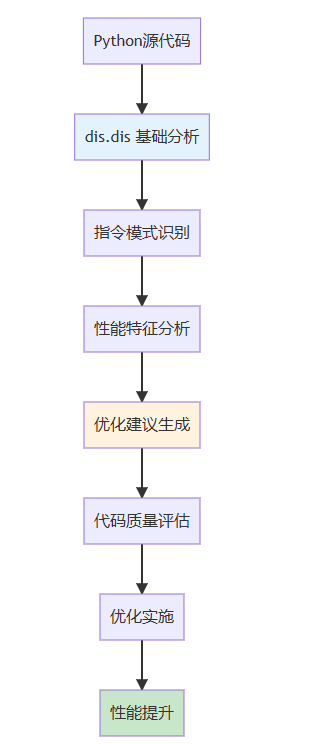
- 性能分析:通过字节码模式识别性能瓶颈和优化机会
- 控制结构模式:if-else、循环、函数调用等都有特定的字节码模式
- 高级特性实现:装饰器、生成器、上下文管理器等的字节码表现
- 优化技巧:常量折叠、窥孔优化、指令选择等编译器优化
- 动态操作:代码对象创建、字节码修补等高级技巧
掌握字节码分析具有重要的实践意义:
- 性能优化:识别性能瓶颈,实施针对性优化
- 代码理解:深入理解Python语言特性和执行机制
- 调试能力:定位复杂问题的根本原因
- 元编程:实现动态代码生成和修改
本文介绍的工具和方法 论包括:
ComprehensiveBytecodeAnalyzer:综合字节码分析工具BytecodeBestPractices:最佳实践检查器CodeQualityChecker:代码质量评估工具- 性能模式识别和优化建议生成
字节码分析是Python高级编程的重要技能,它让我们能够超越表面语法,真正理解代码的执行本质。通过本文的学习,您已经掌握了使用dis模块进行字节码分析的全面技能,能够在实际开发中诊断性能问题、优化代码质量,并深入理解Python语言的运行机制。
记住:优秀的开发者不仅要让代码工作,更要理解代码如何工作。字节码分析正是通向这种深度理解的关键路径。
以上就是Python使用dis模块解析字节码的详细内容,更多关于Python字节码的资料请关注风君子博客其它相关文章!
您可能感兴趣的文章:
- 一文带你深度解密Python的字节码
- Python字节码与程序执行过程详解
- 详解python字节码
- Python使用dis模块把Python反编译为字节码的用法详解
- 深入Python解释器理解Python中的字节码